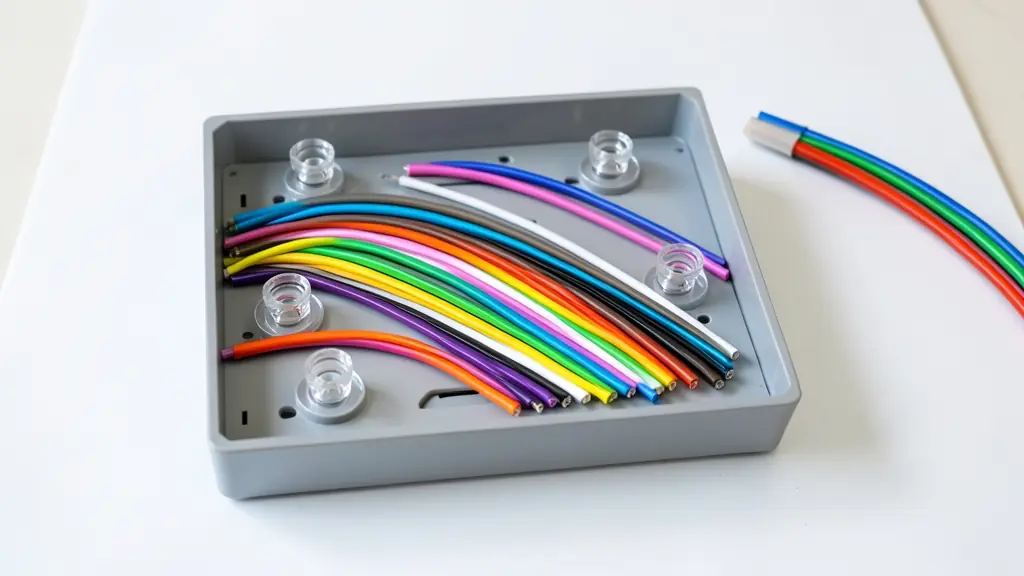
Every fibre in a cable has a colour, and so does every tube that holds them, so a splicer can find core 37 at both ends of a route without guessing. The usual order, from the TIA-598 standard, runs blue, orange, green, brown, slate, white, red, black, yellow, violet, rose and aqua.
The 12 fibre colours
Fibres 1 to 12 in a tube take these colours. In a tube of 24, fibres 13 to 24 repeat them with a black stripe or dashes (black gets a white or yellow one). Tubes follow the same order: tube 1 is blue, tube 2 orange, and so on, and tubes 13 to 24 repeat with a stripe.
| No. | Colour | Also |
|---|---|---|
| 1 | Blue | 13: blue with a black stripe |
| 2 | Orange | 14: orange with a black stripe |
| 3 | Green | 15: green with a black stripe |
| 4 | Brown | 16: brown with a black stripe |
| 5 | Slate | 17: slate with a black stripe |
| 6 | White | 18: white with a black stripe |
| 7 | Red | 19: red with a black stripe |
| 8 | Black | 20: black with a white stripe |
| 9 | Yellow | 21: yellow with a black stripe |
| 10 | Violet | 22: violet with a black stripe |
| 11 | Rose | 23: rose with a black stripe |
| 12 | Aqua | 24: aqua with a black stripe |
Finding a core in a big cable
With 12 fibres per tube, the tube is the core number divided by 12, rounded up, and the fibre is what is left over. Core 37 is in tube 4 (brown), and it is the first fibre in that tube (blue). In a 6 fibre per tube cable, the same core 37 is in tube 7 (red), fibre 1 (blue). Always confirm the fibres per tube on the cable datasheet before splicing: cables with the same core count can be built differently.
Some imported cables follow a different colour order, and some networks number their tubes from a marked master tube. Check the datasheet or the network's splicing standard before you start, and record the colours on the splice sheet. See fibre splicing and splice closures.
Jacket and connector colours
Indoor cable and patch cord jackets show the fibre type: yellow for single-mode (OS1 and OS2), orange for OM1 and OM2 multimode, aqua for OM3 and OM4 (OM4 is sometimes violet), and lime green for OM5. Outdoor cable is usually black whatever the fibre inside, so check the print on the sheath.
Connector bodies tell you the polish: blue for single-mode UPC, green for single-mode APC (angled), beige for older multimode and aqua for OM3 and OM4. Never mate green with blue. See fibre connector types.
A guide, not a design
These figures follow the published standards and common design values, and the calculators work in your browser. They are a guide for planning and checking quotes. The datasheets for your cable and optics, and the network designer or contractor, have the final word. Nothing you type here is sent anywhere.