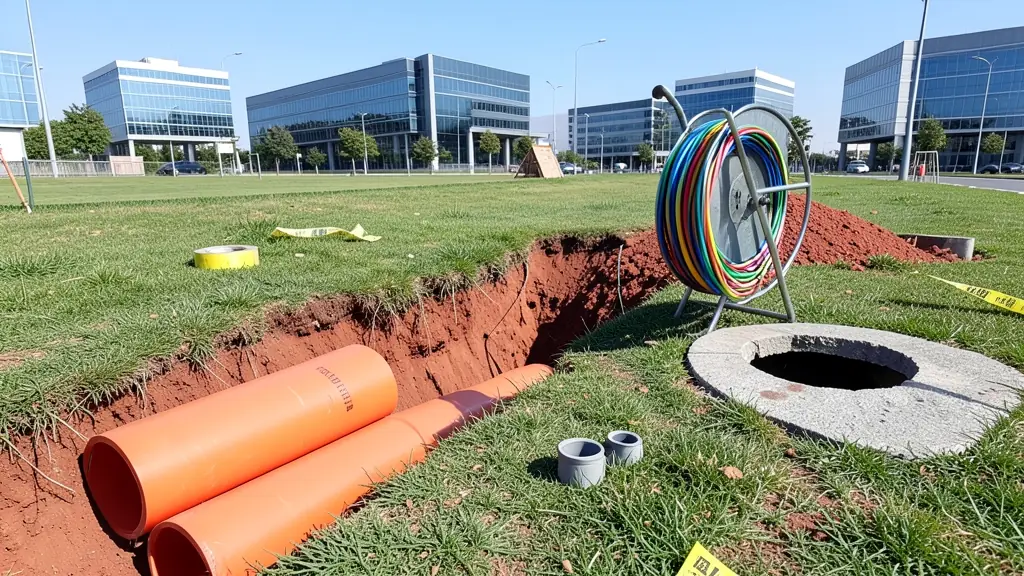
A fibre duct is the pipe the cable lives in underground. HDPE ducts and bundles of microducts protect fibre from digging, rodents and crushing, and they let you pull or blow in new cable later without opening the ground again. The duct work is often a bigger part of a route's cost than the cable, because the trench, the crossings and the reinstatement are the expensive part. Choose the sizes and the number of ducts well and the same route can carry new cables for many years. Here are the parts, the sizes and what a supplier needs to quote.
HDPE ducts and sizes
Fibre outdoors usually runs in HDPE (high-density polyethylene) duct, supplied on coils or drums. Common sizes are often 32, 40, 50 or 110 mm: the smaller ones take a single cable, the larger ones a bundle of microducts or several smaller ducts. Some ducts have a ribbed or low-friction inner lining to make pulling and blowing easier. The duct supplier, the cable supplier and the network designer should agree the duct size against the cable diameter, so ask before you order. Lay a spare duct beside the one you need: it costs little in an open trench and a great deal once the trench is closed.
Microducts and blowing cable
Microducts are small tubes, often in sizes such as 7/3.5 mm or 10/8 mm (outside and inside diameter), sold singly or bundled in a common sheath. Cable is blown into them with compressed air, which carries it long distances with little strain on the cable. Each microduct takes one cable, so a bundle lets an estate or a network add cables one at a time as it grows, and lets different users keep separate cables. Microducts are joined with push-fit connectors that must be airtight for blowing to work, and every tube is capped at its ends until it is used.
Fittings, tape and crossings
- Couplers join lengths of duct; end caps and duct plugs keep out water, soil and rodents until cable goes in, and seal around it afterwards.
- Warning tape goes above the duct in the backfill so the next person digging finds the tape before the cable.
- Sleeves under roads and driveways, laid by open cut or by HDD, protect the crossings. See fibre trenching.
- Draw ropes left in empty ducts make the next pull easier.
The depth, the separation from power cables and the tape position are set by the municipality's wayleave conditions and the network owner's spec, not by a rule of thumb.
Handholes and manholes
Handholes (small pits) and manholes give access along the route for pulling and blowing, storing slack loops and housing splice closures. They go at bends, road crossings and branches, and at intervals along straight runs; the spacing depends on the cable, the method and the network design. Plastic, concrete and composite pits come in several sizes, with lids rated for where they sit: a verge, a driveway or a road. See fibre installation for how the whole route is planned.
What to put in your request
- Route length and number of ducts
- Duct sizes or microduct bundle needed
- Handholes, manholes and crossings
- Ground type and surfaces to reinstate
- Supply only, or supply and lay
Fibre Ducts and Microducts for estates, offices, factories, mines, farms and more
- Houses and home offices: a short duct from the house to a gate, cottage or workshop, often under a driveway
- Estates, complexes and body corporates: ducts and microducts along every street, with handholes at each cluster of homes
- Offices, business parks and shops: ducts between buildings on a business park and out to the street
- Factories, warehouses and plants: ducts across plant yards and under truck roads between buildings
- Mines, quarries and heavy industry: ducts and armoured cable along haul roads and through plant areas
- Farms, wine estates and lodges: ducts along farm roads and under gates to sheds, cellars and pump houses
- Schools, campuses, hospitals and municipalities: ducts linking school, hospital and municipal buildings on one campus
- Data centres and server rooms: duct entries from different sides of the building for separate routes
- Network operators, ISPs and contractors: backbone and FTTH duct routes with microducts in road reserves
Frequently asked questions
What size duct do I need for fibre?
Can fibre duct share a trench with power cables?
Is direct burial cheaper than duct?
Do you sell ducts or dig trenches yourselves?
Fibre Ducts and Microducts by province and city
- Johannesburg
- Pretoria
- Centurion
- Midrand
- Sandton
- Randburg
- Roodepoort
- Krugersdorp
- Randfontein
- Germiston
- Boksburg
- Benoni
- Kempton Park
- Alberton
- Vanderbijlpark
- Vereeniging
- Durban
- Pinetown
- Pietermaritzburg
- Richards Bay
- Newcastle
- Ladysmith
- Gqeberha (Port Elizabeth)
- East London
- Kariega (Uitenhage)
- Mthatha
- Cape Town
- Bellville
- Paarl
- Stellenbosch
- George
- Worcester
- eMalahleni (Witbank)
- Middelburg
- Secunda
- Mbombela (Nelspruit)
- Rustenburg
- Brits
- Klerksdorp
- Potchefstroom
- Mahikeng
- Polokwane
- Tzaneen
- Kimberley
- Upington
- Bloemfontein
- Welkom
- Sasolburg