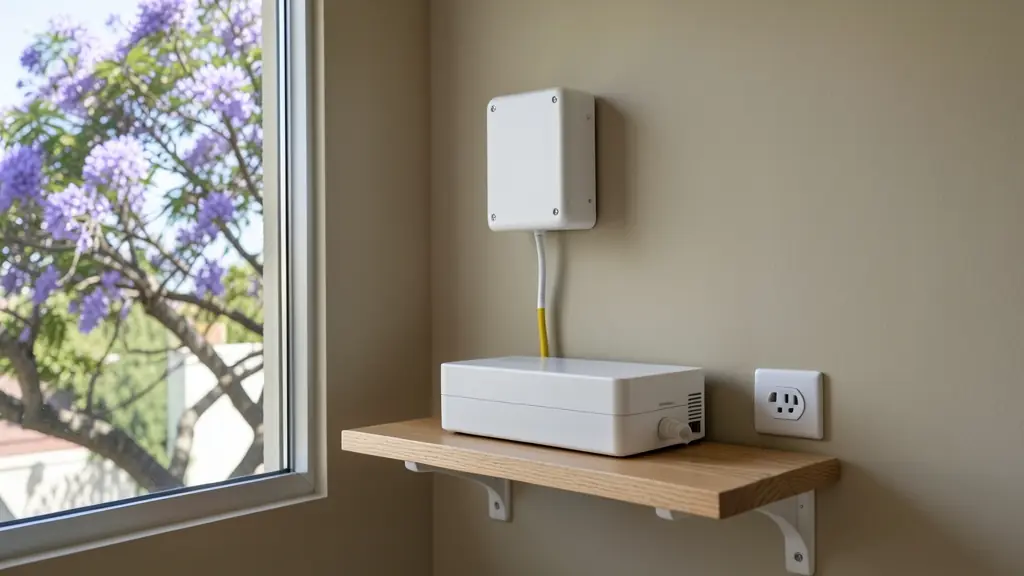
The fibre optic box outside the house, or just inside the front wall, is a termination box: the point where the drop cable from the street ends and a short patch cord takes the signal to the ONT, the "fibre router box" that turns light into a network your Wi-Fi router uses. Termination boxes are small, passive and easy to damage. This page explains the indoor and outdoor types, how many ports they need, how the drop is connected and where the box should go, for homes, units in a complex, offices and the end of a private link.
What the termination box does
Inside the box the drop cable's fibre is either spliced to a pigtail in a small tray or arrives pre-connectorised and plugs into an adapter. From the other side of the adapter, a patch cord (usually SC APC, green) runs to the ONT. It also holds a little slack and protects the bare fibre. Nothing in it is powered: the ONT beside it needs a plug point, and often a small backup supply for load shedding. If you want a home internet package, the network operator that built your street's network installs the drop, the box and the ONT, and an internet service provider sells the package; we do neither. Our quotes are for private work on estates, complexes, offices and your own links.
Indoor and outdoor boxes, and how many ports
Indoor boxes are small white plastic housings for a passage wall or a cupboard near where the router will sit. Outdoor boxes are UV-stable and sealed against rain and dust, for a garage wall or the outside wall of a unit, with an indoor box or a cord through the wall. Most homes need one or two ports; a box with two or four leaves room for a spare. Offices, shops and units in a complex use the same boxes with more ports, and a small wall box at the end of a private fibre optic cable link to a gate or outbuilding works the same way.
Where the box should go
Put the box where the drop cable can reach it without tight bends, where the ONT can sit beside it on a plug point, and where the Wi-Fi router will cover the house: usually near the middle, not in a back corner of the garage. Keep it away from banging doors and furniture. The drop is routed along skirtings, in conduit or through the ceiling with gentle curves, never stapled tight or pinched under a door. See FTTH drop cable for the cable itself.
What not to do
Don't open the box to look inside, don't pull the green connector out to check it, and never look into a fibre end or connector: the light is invisible infrared, so it can be on even when it seems dark. Don't bend or coil the drop tightly to hide it, don't paint over the box, and don't move it yourself. If the box or cable is damaged, call whoever owns it: on a private estate network that may be the body corporate's contractor, and for a repair on your own link, a splicing team.
What to put in your request
- Number of homes, units or link ends
- Indoor, outdoor or both at each point
- Drops spliced or pre-connectorised
- Connector type and number of ports
- Who owns the network and the ONTs
Fibre Termination Boxes for estates, offices, factories, mines, farms and more
- Houses and home offices: the small box on a passage wall or outside wall where the drop from the street ends
- Estates, complexes and body corporates: one box in each house or unit, fed by drops from the estate's own network
- Offices, business parks and shops: boxes in shops and small offices where a business fibre line comes in
- Factories, warehouses and plants: wall boxes in guard huts, stores and workshops at the end of site links
- Mines, quarries and heavy industry: sealed wall boxes in site offices and workshops at the ends of plant links
- Farms, wine estates and lodges: a box in the farmhouse, cellar, shed or pump house at the end of a farm fibre run
- Schools, campuses, hospitals and municipalities: boxes in clinics, classrooms and offices at the end of campus links
- Data centres and server rooms: rarely, apart from small wall boxes in a client's suite or meet-me room
- Network operators, ISPs and contractors: boxes by the hundred in FTTH rollouts, one in every home connected
Frequently asked questions
Is the fibre box outside my house mine?
Can the termination box be moved to another room?
How many ports does a termination box need?
Do you install home fibre or sell termination boxes?
Fibre Termination Boxes by province and city
- Johannesburg
- Pretoria
- Centurion
- Midrand
- Sandton
- Randburg
- Roodepoort
- Krugersdorp
- Randfontein
- Germiston
- Boksburg
- Benoni
- Kempton Park
- Alberton
- Vanderbijlpark
- Vereeniging
- Durban
- Pinetown
- Pietermaritzburg
- Richards Bay
- Newcastle
- Ladysmith
- Gqeberha (Port Elizabeth)
- East London
- Kariega (Uitenhage)
- Mthatha
- Cape Town
- Bellville
- Paarl
- Stellenbosch
- George
- Worcester
- eMalahleni (Witbank)
- Middelburg
- Secunda
- Mbombela (Nelspruit)
- Rustenburg
- Brits
- Klerksdorp
- Potchefstroom
- Mahikeng
- Polokwane
- Tzaneen
- Kimberley
- Upington
- Bloemfontein
- Welkom
- Sasolburg