If a link leaves the building, it is almost always single-mode. Single mode fibre has a core of about 9 µm, small enough that light travels in one path, so it carries signals for kilometres with very little loss. It is the fibre network operators use, the fibre most installers recommend between buildings, and the fibre that keeps working when you swap 1 Gb/s equipment for 10 Gb/s or more. This page covers the specs to ask for, the wavelengths, indoor and outdoor constructions, and what a supplier needs to quote your cable.
The specs to ask for
- ITU-T G.652.D: the everyday single-mode fibre for outdoor and backbone cable.
- G.657.A1 and A2: bend-insensitive fibre for drops, tight corners and small boxes. A2 takes tighter bends.
- OS1: the cabling standards' name for indoor tight buffered single-mode.
- OS2: loose tube, low water peak single-mode for outdoor and long runs.
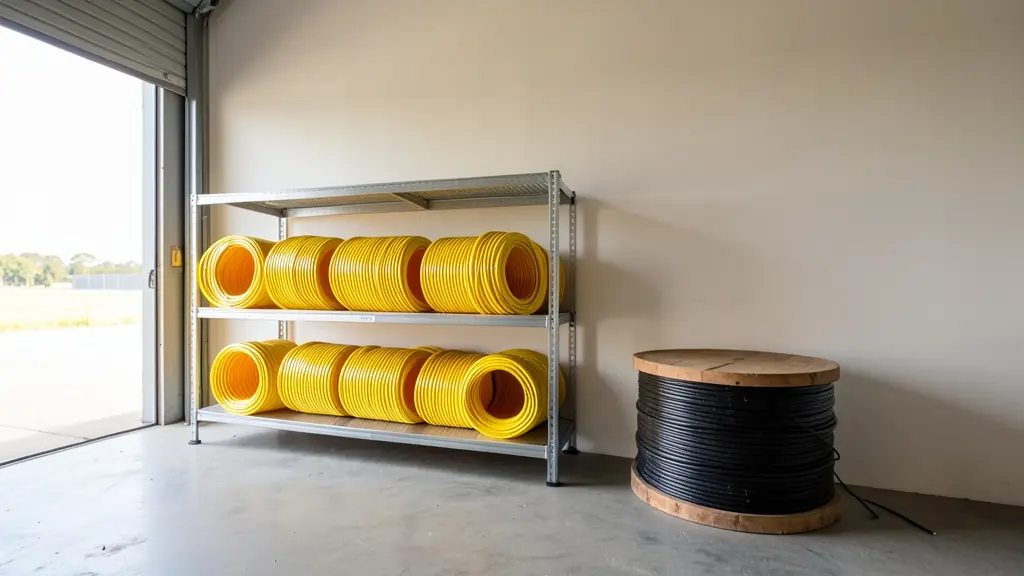
Indoor single-mode cable and patch cords usually have a yellow jacket, which makes them easy to tell from aqua multimode in a rack.
Wavelengths and distance
Single-mode equipment runs at 1310 nm and 1550 nm, and PON networks also use 1490 and 1577 nm downstream. Typical design loss is about 0.35 to 0.4 dB per km at 1310 nm and about 0.25 to 0.3 dB per km at 1550 nm; the cable datasheet gives the maximum. That is why a single-mode link can run tens of kilometres where multimode stops at a few hundred metres. The reach of a particular link is set by the optics in the equipment and the total loss of fibre, splices and connectors, so ask for a loss budget with the design.
Outdoor loose tube and indoor tight buffered
Outdoors, single-mode comes as loose tube cable in black polyethylene for ducts and burial, as armoured cable where rodents, termites or rocky ground are a risk, and as ADSS or figure-8 for aerial routes. Indoors it comes as tight buffered distribution cable, often LSZH, that is easy to terminate in a patch panel. A common pattern is loose tube between buildings, spliced to pigtails in a panel at each end. Ask for spare cores: 12 or 24 is common between buildings, and the tubes and fibres follow a colour code so the splicer can identify each one.
Why most new links are single-mode
Single-mode optics used to cost far more than multimode. The gap has narrowed, and a single-mode link between buildings handles faster equipment later without new cable. The same glass can carry much faster optics years later, and where cores are tight, BiDi modules send both directions over one fibre in matched pairs, freeing spares. For runs inside one building or one data centre hall, multimode can still be cheaper overall. Match the SFP modules or media converters to the fibre: single-mode LR or longer reach, the right wavelength and the right connector.
What to put in your request
- The route length and the number of runs
- The core count, with spares
- Indoor, duct, buried or aerial
- Any network spec, such as G.657.A2
- Whether splicing and testing are needed
Single-Mode Fibre Cable for estates, offices, factories, mines, farms and more
- Houses and home offices: a long buried link to a cottage, workshop or gate on a big property
- Estates, complexes and body corporates: backbone and distribution cable through an estate's duct network
- Offices, business parks and shops: links between buildings on a business park and up to the server room
- Factories, warehouses and plants: links between plants, warehouses and gatehouses across a site
- Mines, quarries and heavy industry: kilometres of link between shafts, plants and the control room
- Farms, wine estates and lodges: long runs to pump houses, cellars and staff houses across the farm
- Schools, campuses, hospitals and municipalities: campus backbones between hospital wings, school blocks and offices
- Data centres and server rooms: single-mode structured cabling for every optic in the hall
- Network operators, ISPs and contractors: feeder, backbone and distribution cable for operators and wireless ISPs
Frequently asked questions
Do you supply single-mode cable yourselves?
No. We pass your request to independent fibre cable suppliers and installers in your area, and they quote you directly. We sell and install nothing ourselves. Tell us the route, the core count and the construction, and they can also quote laying, splicing and testing.
Is G.657 fibre compatible with G.652.D?
Both are single-mode with the same 9/125 geometry, and installers splice them together routinely, for example a G.657 drop onto a G.652.D distribution cable. Check the datasheets if your network has a strict spec.
Can I use single-mode for a short link indoors?
Yes. Many server rooms now run single-mode throughout so that one type of optic and patch cord covers every link. The cost difference is mostly in the optics; ask your installer to price both.
How many cores do I need between two buildings?
Two fibres carry a typical Ethernet link, or one with BiDi optics. Most installers recommend at least 12 cores on a buried route so there are spares for cameras, access control and future links without digging again.
Single-Mode Fibre Cable by province and city
- Johannesburg
- Pretoria
- Centurion
- Midrand
- Sandton
- Randburg
- Roodepoort
- Krugersdorp
- Randfontein
- Germiston
- Boksburg
- Benoni
- Kempton Park
- Alberton
- Vanderbijlpark
- Vereeniging
- Durban
- Pinetown
- Pietermaritzburg
- Richards Bay
- Newcastle
- Ladysmith
- Gqeberha (Port Elizabeth)
- East London
- Kariega (Uitenhage)
- Mthatha
- Cape Town
- Bellville
- Paarl
- Stellenbosch
- George
- Worcester
- eMalahleni (Witbank)
- Middelburg
- Secunda
- Mbombela (Nelspruit)
- Rustenburg
- Brits
- Klerksdorp
- Potchefstroom
- Mahikeng
- Polokwane
- Tzaneen
- Kimberley
- Upington
- Bloemfontein
- Welkom
- Sasolburg