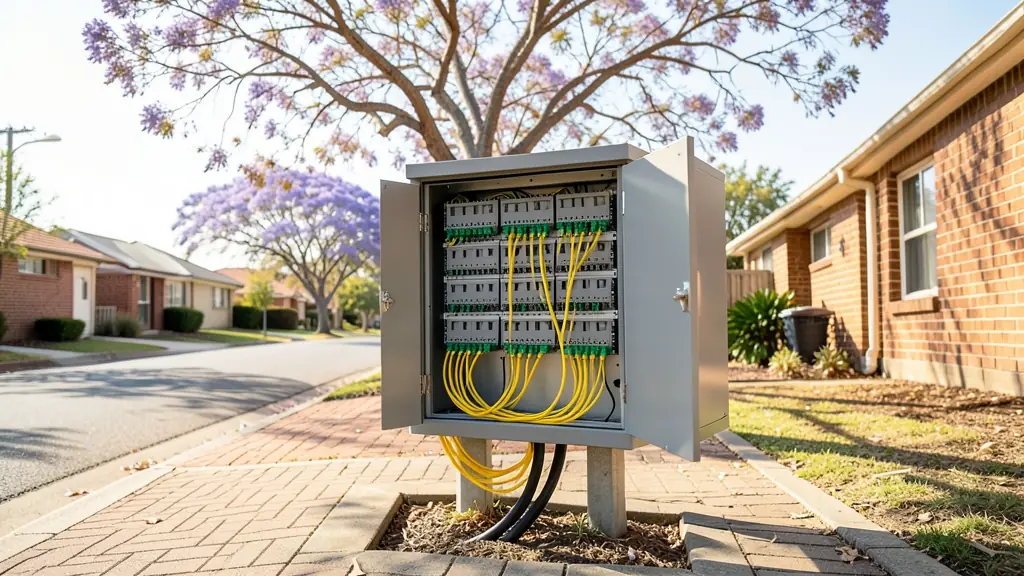
A fibre optic splitter takes the light in one fibre and shares it across 2, 4, 8, 16, 32 or 64 fibres, with no power and no moving parts. Splitters are what make a passive optical network (PON) work: one port on the operator's OLT can serve a whole street of homes. They also turn up on some estate and campus networks. Every split costs light, and the network only works if the total loss stays inside the optics' budget. Here is how the types, ratios and losses fit together, and what to send a supplier for a quote.
PLC and FBT splitters
PLC (planar lightwave circuit) splitters are made on a small chip and divide the light evenly across all outputs over a wide band of wavelengths, which is why they are the standard for GPON and XGS-PON. FBT (fused biconic taper) splitters are made by fusing fibres together; they are cheap in low ratios such as 1:2 and can split unevenly, for example 70/30, but they are more sensitive to wavelength. For anything above 1:4 on a PON network, ask for PLC.
Ratios and losses
Every time the light is halved you lose about 3 dB, plus a little for the device itself. Typical maximum insertion loss, from the datasheets, is about:
- 3.6 dB for 1:2 and 7.2 dB for 1:4
- 10.5 dB for 1:8 and 13.8 dB for 1:16
- 17.1 dB for 1:32 and 20.5 dB for 1:64
Splits are often cascaded, for example a 1:4 in the street cabinet and a 1:8 at each distribution point, giving 1:32 in total. Add the fibre, splices and connectors, and the whole path from OLT to ONT must stay inside the optics' loss budget; GPON class B+ optics are often quoted at 28 dB. The network designer works that out, not the splitter supplier. Our FTTH installation page covers the design.
Bare, cassette, box and rack splitters
A bare or steel tube splitter is a small sleeve with fibre leads, spliced into a tray in a closure. A cassette splitter has connectorised outputs and slides into a frame in a cabinet or panel. Box splitters have leads coming out of a small plastic housing, and rack-mount splitters fill a 1U panel with adapters. Outputs come with SC APC or LC APC connectors, or with bare ends for splicing. Choose by where it goes: a splice closure on a pole, a distribution point in a handhole, a street cabinet or a rack.
Estates, campuses and private networks
Estates and business parks building their own FTTH network use the same splitters, in a cabinet at the entrance and distribution points along the streets. Splitters are rare on point-to-point links such as camera networks or links between two buildings, where each camera or switch usually has its own fibre and ordinary media converters or SFPs. If you are not sure whether your design needs splitters at all, ask the network designer before you buy.
What to put in your request
- Split ratio and number of splitters
- Cassette, box, rack or bare for splicing
- Connector type, usually SC APC or LC APC
- Where they go: cabinet, closure or rack
- Homes or units to be served
Fibre Optic Splitters for estates, offices, factories, mines, farms and more
- Houses and home offices: not usually needed, as a single home link has its own fibre
- Estates, complexes and body corporates: splitters in the entrance cabinet and street distribution points of the estate network
- Offices, business parks and shops: splitters in business park FTTH networks serving many tenants
- Factories, warehouses and plants: now and then on PON networks across large plants and logistics yards
- Mines, quarries and heavy industry: PON in mine villages and site offices, rare on control links
- Farms, wine estates and lodges: rare, except on farms with many cottages on one network
- Schools, campuses, hospitals and municipalities: PON across university residences, hospital campuses and housing projects
- Data centres and server rooms: rare in data centres, which mostly patch point to point
- Network operators, ISPs and contractors: splitters in every street cabinet and distribution point of an FTTH rollout
Frequently asked questions
What split ratio should I use?
Can a splitter share one fibre between two buildings?
Should the splitter connectors be APC or UPC?
Do you sell splitters or build PON networks yourselves?
Fibre Optic Splitters by province and city
- Johannesburg
- Pretoria
- Centurion
- Midrand
- Sandton
- Randburg
- Roodepoort
- Krugersdorp
- Randfontein
- Germiston
- Boksburg
- Benoni
- Kempton Park
- Alberton
- Vanderbijlpark
- Vereeniging
- Durban
- Pinetown
- Pietermaritzburg
- Richards Bay
- Newcastle
- Ladysmith
- Gqeberha (Port Elizabeth)
- East London
- Kariega (Uitenhage)
- Mthatha
- Cape Town
- Bellville
- Paarl
- Stellenbosch
- George
- Worcester
- eMalahleni (Witbank)
- Middelburg
- Secunda
- Mbombela (Nelspruit)
- Rustenburg
- Brits
- Klerksdorp
- Potchefstroom
- Mahikeng
- Polokwane
- Tzaneen
- Kimberley
- Upington
- Bloemfontein
- Welkom
- Sasolburg