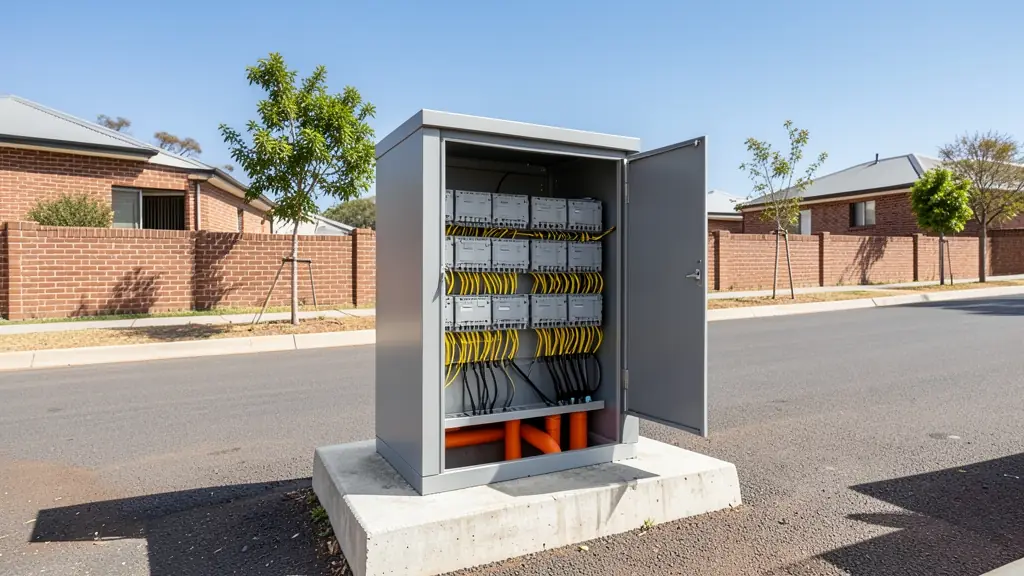
FTTH (fibre to the home) brings a fibre from a street cabinet or an estate entrance all the way into each house or unit. For an estate, a complex, a business park or a new development, that means designing a passive optical network, laying ducts or a pole route, splicing splitters into cabinets and distribution points, and running a drop cable to a termination box in every home. This page explains how an FTTH network is built and who owns and runs it. Send one request and FTTH contractors near you quote directly.
How an FTTH network is laid out
The network operator brings a feeder fibre to a cabinet at the estate entrance or in the street. Distribution cable runs along the roads in ducts or on poles to distribution points in handholes or on poles, each serving a few homes. From there a drop cable goes to each home's termination box, and a patch cord connects it to the ONT. It is a passive optical network (PON): one fibre from the operator's OLT is shared among many homes through passive splitters, often cascaded, for example 1:4 then 1:8. GPON is the most common in South Africa, with XGS-PON going in for higher speeds.
Design and loss budget
The designer chooses the split ratios and where the splitters sit, the fibre counts with spares for future homes, the duct sizes, and the cabinet and closure positions. The total loss from OLT to ONT, through fibre, splices, connectors and splitters, must stay inside the optics' loss budget. A 1:32 split alone is about 17 dB, so there is not much left over. The planner on this page gives a rough splitter and drop estimate, but the network designer works it out properly.
Homes passed and homes connected
FTTH is usually priced per home passed (the ducts, cable, cabinet and distribution points that bring fibre past a home) and per home connected (the drop, termination box and patching for a home that signs up). On a new development, it is cheapest to lay ducts with the other services before roads and paving go in. In an existing estate, the civils through gardens, paving and tar decide much of the cost.
Who owns the network
Some estates and complexes build and own their duct and fibre network and let one or more operators use it, an open access network. In others a network operator builds and owns it. The body corporate or HOA decides, so ask who will own, maintain and repair the network, who pays when a contractor cuts it, and whether residents can choose between internet service providers, before anything is signed.
What to put in your request
- Number of homes or units, now and later
- Ducts already laid or civils needed
- Ducts or a pole route along the roads
- Operator involved, or estate-owned network
- Drops and termination boxes per home
FTTH Installation for estates, offices, factories, mines, farms and more
- Houses and home offices: a duct and termination box ready in a new house before handover
- Estates, complexes and body corporates: a full PON network from the gatehouse cabinet to every house
- Offices, business parks and shops: fibre to each unit on a business park, often open access
- Factories, warehouses and plants: fibre to each unit in an industrial park or mini-factory complex
- Mines, quarries and heavy industry: PON networks in mine villages and staff housing
- Farms, wine estates and lodges: fibre to staff houses, cottages and lodges on a farm or game reserve
- Schools, campuses, hospitals and municipalities: fibre to housing on a university campus or a municipal development
- Data centres and server rooms: the OLT end of a PON, patched in a comms room or data centre
- Network operators, ISPs and contractors: build and connect contracts for operators and wireless ISPs
Frequently asked questions
Do you build FTTH networks yourselves?
Can you get fibre internet installed at my house?
Should our estate build its own network?
What does a developer need to plan early?
FTTH Installation by province and city
- Johannesburg
- Pretoria
- Centurion
- Midrand
- Sandton
- Randburg
- Roodepoort
- Krugersdorp
- Randfontein
- Germiston
- Boksburg
- Benoni
- Kempton Park
- Alberton
- Vanderbijlpark
- Vereeniging
- Durban
- Pinetown
- Pietermaritzburg
- Richards Bay
- Newcastle
- Ladysmith
- Gqeberha (Port Elizabeth)
- East London
- Kariega (Uitenhage)
- Mthatha
- Cape Town
- Bellville
- Paarl
- Stellenbosch
- George
- Worcester
- eMalahleni (Witbank)
- Middelburg
- Secunda
- Mbombela (Nelspruit)
- Rustenburg
- Brits
- Klerksdorp
- Potchefstroom
- Mahikeng
- Polokwane
- Tzaneen
- Kimberley
- Upington
- Bloemfontein
- Welkom
- Sasolburg