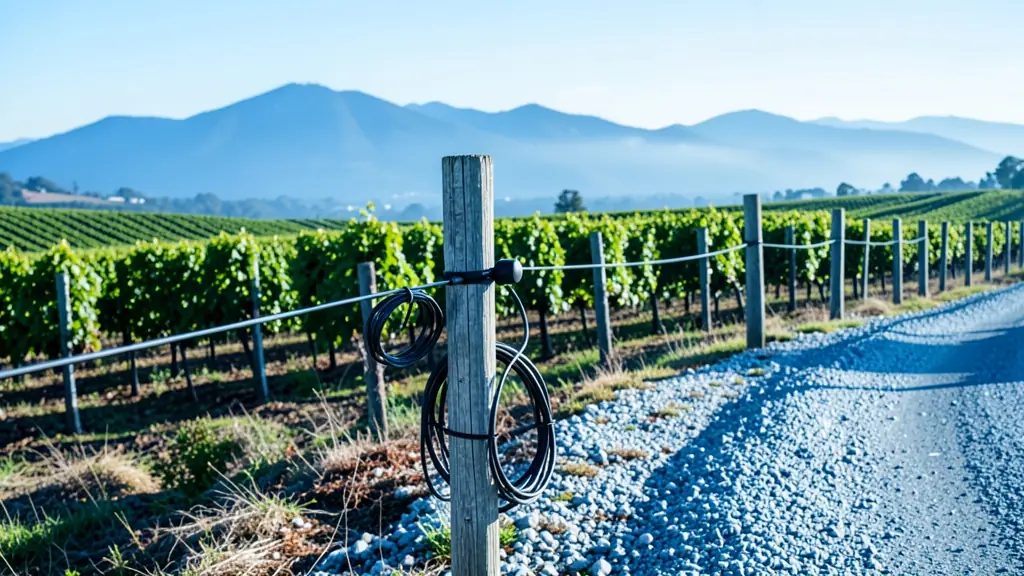
Where a trench would be long, rocky or expensive, the cable can go up on poles instead. Aerial fibre installation is common on farms, along rural roads, on wireless ISP routes and in suburbs where poles already stand. It is quicker to build than a buried route and easier to reach for repairs, but it brings its own questions: which cable, whose poles, how long the spans, and how to keep it clear of fire and wind. This page covers ADSS and figure-8 cable, spans and sag, permission from pole owners, fittings and closures.
ADSS or figure-8
- ADSS (all-dielectric self-supporting): no metal at all, with strength members that carry its own weight. Spans are set by its design. The usual choice near power lines and on long routes.
- Figure-8: the fibre cable joined to a steel messenger wire, so the profile looks like an 8. The messenger carries the load and must be earthed.
Both are usually loose tube single-mode in UV-stable black polyethylene. Drops from the poles to homes use drop cable.
Spans, sag and clearance
How far apart the poles can be, how much the cable sags in summer heat, how much clearance it needs over roads and driveways, and what wind it can take all come from the cable maker's tables and the pole owner's rules. Don't guess them. A longer span needs a stronger cable, and an ADSS cable chosen for short suburban spans may not suit a farm route with long gaps. Ask the supplier for the span table for the cable they quote. On a long route the crew also plans where drums meet, because each join needs a closure on a pole, and where slack loops will hang for future repairs.
Poles and permission
The cable can go on your own poles, on new wooden or steel poles, or on poles owned by a municipality, the electricity utility or a network operator. On anyone else's poles you need the pole owner's permission and you follow their attachment rules, which may set heights, fittings and who may climb. Work at height falls under the Construction Regulations, so the crew needs fall protection and, on roads, traffic control. Ask who will get permission and how long it usually takes, and whether the quote includes the poles, the holes, any concrete, and stays at corners and ends.
Fittings, closures and risks
An aerial route uses tension clamps at dead ends and corners, suspension clamps on straight runs, down-lead clamps where the cable comes down a pole, and slack storage brackets. Splice closures mount on the poles where drums meet or branches leave. The usual risks are veld fires burning under the line, storms and wind, and vehicles hitting poles. Clear grass under the route and keep spare cable on site for repairs.
What to put in your request
- The route length and the number of poles
- Whose poles: yours, new, or another owner's
- Typical span length between poles
- Road crossings and power lines nearby
- The core count, with spares
Aerial Fibre Cable for estates, offices, factories, mines, farms and more
- Houses and home offices: a span from the house to a gate, cottage or shed on a smallholding
- Estates, complexes and body corporates: pole routes along perimeter fences to cameras and security towers
- Offices, business parks and shops: a span across a yard or road between two buildings on one property
- Factories, warehouses and plants: routes on existing site poles between plants and yards
- Mines, quarries and heavy industry: temporary or permanent links on poles across open mine ground
- Farms, wine estates and lodges: kilometres along farm roads to houses, sheds, cellars and pump houses
- Schools, campuses, hospitals and municipalities: links across large campuses and to outlying clinics and depots
- Data centres and server rooms: rarely used, except to reach a nearby site across open ground
- Network operators, ISPs and contractors: wireless ISP routes and suburban distribution on existing poles
Frequently asked questions
Do you put up aerial fibre yourselves?
No. We pass your request to independent aerial crews, fibre installers and cable suppliers in your area, who quote you directly. We do no installation ourselves and own no poles.
Is aerial cheaper than trenching?
Often, when poles already exist or the ground is rocky. New poles, permission and fire risk change the picture. Ask contractors to quote both an aerial and a buried route if you are unsure. Fire breaks under the line and spare cable on site are part of the running cost.
Can I use any outdoor cable on poles?
No. Duct cable is not built to hang. Use ADSS or figure-8 cable rated for your span lengths, and fittings made for that cable's diameter. The supplier needs your span lengths to quote the right cable.
Can fibre go on poles that carry power lines?
Sometimes, with the owner's permission and following their rules. ADSS is the usual choice there because it has no metal. That is a decision for the pole owner and the network designer, not the installer alone.
Aerial Fibre Cable by province and city
- Johannesburg
- Pretoria
- Centurion
- Midrand
- Sandton
- Randburg
- Roodepoort
- Krugersdorp
- Randfontein
- Germiston
- Boksburg
- Benoni
- Kempton Park
- Alberton
- Vanderbijlpark
- Vereeniging
- Durban
- Pinetown
- Pietermaritzburg
- Richards Bay
- Newcastle
- Ladysmith
- Gqeberha (Port Elizabeth)
- East London
- Kariega (Uitenhage)
- Mthatha
- Cape Town
- Bellville
- Paarl
- Stellenbosch
- George
- Worcester
- eMalahleni (Witbank)
- Middelburg
- Secunda
- Mbombela (Nelspruit)
- Rustenburg
- Brits
- Klerksdorp
- Potchefstroom
- Mahikeng
- Polokwane
- Tzaneen
- Kimberley
- Upington
- Bloemfontein
- Welkom
- Sasolburg