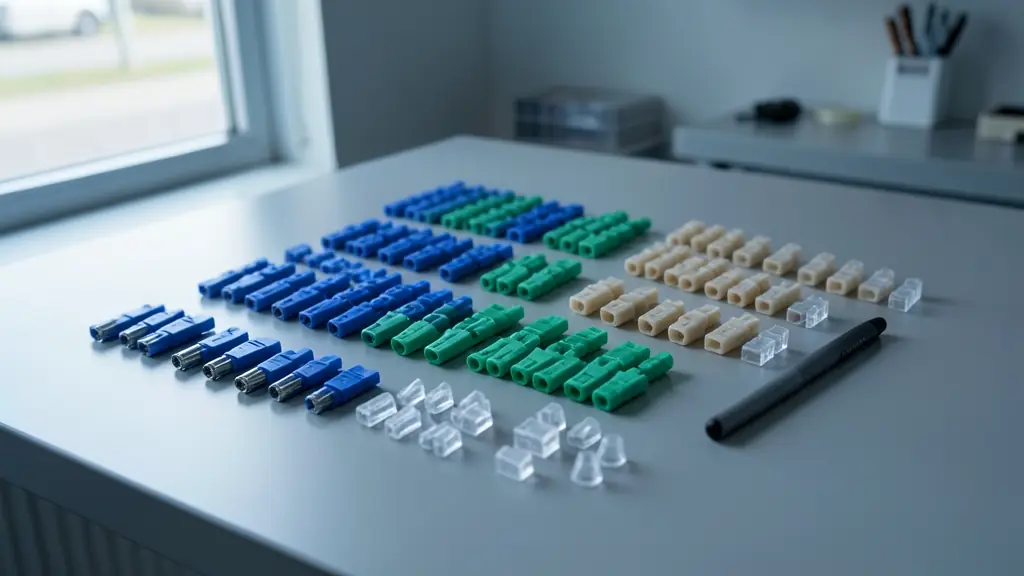
Every time light passes from one fibre to the next through a connector, some of it is lost, and dirt or a wrong match can lose a lot. Choosing the right fibre connectors is about the equipment, the space and the network: LC for most panels and switches, SC on FTTH, MPO in data centres. Then there is the end face, UPC or APC, and the method, factory-terminated pigtails or connectors fitted on site. This page covers each type and where it is used, adapters, the ways to put a connector on, typical loss and cleaning.
The connector types
- LC: small, with a latch, usually in duplex pairs. The most common connector in patch panels and SFP modules.
- SC: square, push-pull. Common in FTTH and older panels.
- ST: round bayonet. Found on older multimode installations.
- FC: screw-on. Used on test gear and some older networks.
- MPO: 8, 12, 16 or 24 fibres in one ferrule, for data centre trunks, with polarity types A, B and C.
Keep one type throughout a site where you can: fewer hybrid cords, fewer mistakes when someone patches in a hurry.
UPC versus APC
The end face of the ferrule is polished flat (UPC) or angled at 8 degrees (APC). APC reflects less light back down the fibre, which is why it is standard on FTTH and video. The colours tell you: single-mode UPC bodies are usually blue, APC green, multimode beige or aqua. Never mate APC with UPC: it damages both end faces and adds loss. Patch cords with mixed ends join APC and UPC equipment the right way.
Adapters and how connectors go on
Adapters (couplers) join two connectors in a patch panel or wall box; they come simplex or duplex, in each type, and in hybrid versions such as SC to LC. Connectors go on in three ways:
- Splice-on pigtails: factory-polished pigtails fusion spliced to the cable. The usual method in panels and closures. See fibre splicing.
- Epoxy and polish: fibre glued into the connector and polished by hand or machine.
- Field-installable (fast) connectors: a mechanical connector fitted with a cleaver and no splicer, for drops and quick restorations.
Splice-on pigtails need a fusion splicer and a trained splicer; epoxy and polish takes time and skill; field-installable connectors cost more each but need the least equipment.
Loss, inspection and cleaning
A mated pair of good connectors often loses about 0.3 to 0.5 dB; the cabling standards allow up to 0.75 dB. A link with several panels adds this up quickly, so the designer counts connectors in the loss budget. Dirty connectors are the most common cause of high loss. Inspect and clean before every connection, use a probe graded against IEC 61300-3-35, and keep dust caps on. Never look into a connector. Testing shows whether each connection is within budget.
What to put in your request
- The connector type and end face, such as LC/UPC
- Single-mode or multimode
- Loose connectors, pigtails or adapters
- Quantities of each
- Whether you need them fitted and tested
Fibre Optic Connectors for estates, offices, factories, mines, farms and more
- Houses and home offices: an SC/APC connection in the termination box at the house
- Estates, complexes and body corporates: connectors in gatehouse cabinets, street cabinets and home boxes
- Offices, business parks and shops: LC connectors and adapters in panels and on switches
- Factories, warehouses and plants: rugged connectors in control panels and plant switch cabinets
- Mines, quarries and heavy industry: connectors in control rooms and sealed plant enclosures
- Farms, wine estates and lodges: field-installable connectors on drops to small buildings
- Schools, campuses, hospitals and municipalities: LC terminations in school and hospital comms rooms
- Data centres and server rooms: high density LC and MPO connections across every rack
- Network operators, ISPs and contractors: SC/APC and LC terminations in cabinets, closures and exchanges
Frequently asked questions
Do you supply or fit connectors yourselves?
No. We pass your request to independent suppliers and fibre installers in your area, who quote you directly. We stock nothing and do no termination work ourselves.
Which connector should I choose for a new installation?
Match the equipment first. For most switches and panels that means LC. For FTTH, SC/APC is common. Ask the network designer or installer, and keep one type throughout where you can. If you are extending an existing installation, take a photo of the panel and the ports and include it with your request.
Are field-installable connectors as good as spliced pigtails?
A spliced pigtail usually gives lower and more consistent loss. Field-installable connectors are quicker for drops and emergency repairs and need no splicer. Many installers use both, each where it suits.
Can a damaged connector be repaired?
A dirty one can be cleaned. A scratched or chipped end face usually means cutting it off and fitting or splicing a new connector. Inspect it with a probe first: what looks like damage is often dirt. See fibre optic repairs.
Fibre Optic Connectors by province and city
- Johannesburg
- Pretoria
- Centurion
- Midrand
- Sandton
- Randburg
- Roodepoort
- Krugersdorp
- Randfontein
- Germiston
- Boksburg
- Benoni
- Kempton Park
- Alberton
- Vanderbijlpark
- Vereeniging
- Durban
- Pinetown
- Pietermaritzburg
- Richards Bay
- Newcastle
- Ladysmith
- Gqeberha (Port Elizabeth)
- East London
- Kariega (Uitenhage)
- Mthatha
- Cape Town
- Bellville
- Paarl
- Stellenbosch
- George
- Worcester
- eMalahleni (Witbank)
- Middelburg
- Secunda
- Mbombela (Nelspruit)
- Rustenburg
- Brits
- Klerksdorp
- Potchefstroom
- Mahikeng
- Polokwane
- Tzaneen
- Kimberley
- Upington
- Bloemfontein
- Welkom
- Sasolburg