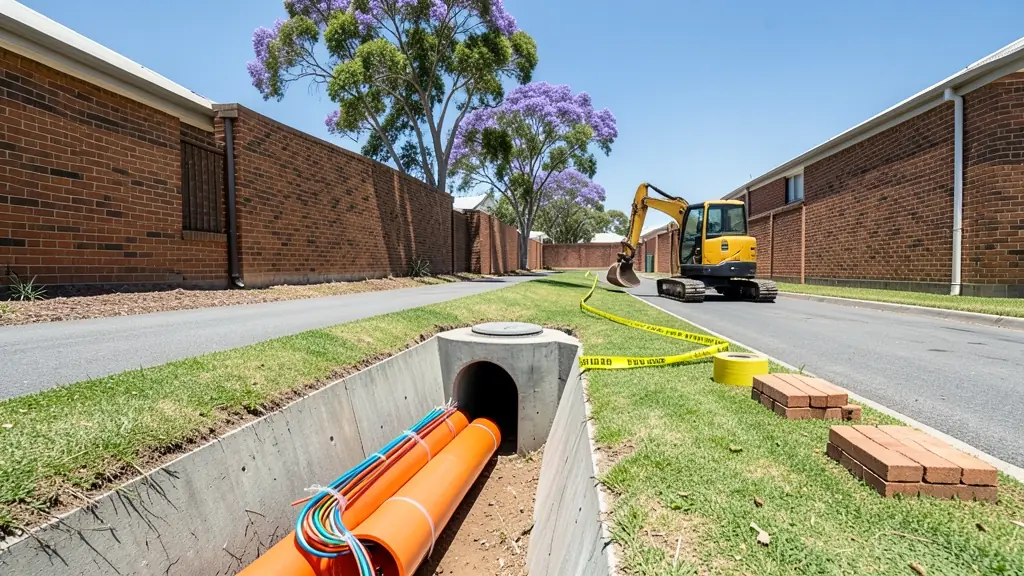
Fibre trenching is usually the biggest cost on an outdoor fibre route, far more than the cable that goes in it. The civils contractor finds the existing services, gets the wayleaves, digs or drills the route, lays ducts and handholes, backfills with warning tape and puts the paving, tar and kerbs back. The method depends on the ground and what is in the way: open trenching, micro-trenching, horizontal directional drilling or moling. This page explains each, what sets the depth and the price, and what a quote must include. Send one request and civil contractors near you quote directly.
Open trenching, micro-trenching, HDD and moling
Open trenching by hand or machine suits lawns, verges and open ground. Micro-trenching cuts a narrow slot in a road or pavement with a saw, lays microducts and reinstates it, which is quick in built-up areas where the municipality allows it. Horizontal directional drilling (HDD) bores under roads, rivers, rail lines and driveways without digging them up, and moling does short crossings under paving. Ground matters: sand trenches easily but collapses, clay is heavy when wet, and rock or dolomite may need breaking or drilling, which changes the price per metre a lot.
Locating services and getting wayleaves
Before anyone digs, existing power, water, gas and telecom services must be found from service drawings, cable locators, ground-penetrating radar and trial holes. Hitting a power cable is dangerous; hitting someone else's fibre is expensive. A wayleave is permission to dig: from the municipality in a road reserve, the national roads agency next to a national road, the rail operator in a rail reserve, or a private landowner. Wayleave approval can take weeks. The trench depth, warning tape, separation from power cables and reinstatement are set by the wayleave conditions and the network owner's spec, so ask the contractor what applies to your route rather than going by a figure off the internet.
Ducts, handholes and spares
Fibre usually goes into HDPE ducts or microducts rather than straight into the soil, so the cable can be pulled or blown in and replaced later without digging. Handholes or manholes go in at intervals and at bends for pulling, slack loops and closures. Laying a spare duct costs little while the trench is open and saves a whole dig later. Where cable goes straight into the ground, it should be armoured with warning tape above it.
Reinstatement and safety
A proper quote includes putting back paving, tar, kerbs and lawn. Trenching falls under the Construction Regulations: trench safety and shoring, barriers, and traffic control on roads. Trenching is priced per metre, and the ground type, hard surfaces, crossings, HDD and reinstatement change it hugely, so they are often separate lines. Ask for as-built drawings of where the ducts actually went.
What to put in your request
- Route length and the ground along it
- Surfaces to cut: paving, tar, kerbs, lawn
- Road, driveway and river crossings
- Number and size of ducts, and handholes
- Whether wayleaves are needed and from whom
Fibre Trenching and Civils for estates, offices, factories, mines, farms and more
- Houses and home offices: a short trench across a garden to a cottage, workshop or gate
- Estates, complexes and body corporates: ducts along estate roads to the gatehouse, clubhouse and every unit
- Offices, business parks and shops: trenching and HDD between buildings across a business park
- Factories, warehouses and plants: duct routes across yards, under roadways and to new warehouses
- Mines, quarries and heavy industry: long trenches and crossings between shafts, plants and offices
- Farms, wine estates and lodges: long runs along farm roads, fence lines and vineyards to outbuildings
- Schools, campuses, hospitals and municipalities: ducts between school blocks, hospital buildings and campus sites
- Data centres and server rooms: diverse duct routes and road crossings into a data centre site
- Network operators, ISPs and contractors: municipal wayleaves, micro-trenching and HDD for operator builds
Frequently asked questions
Do you dig trenches yourselves?
How deep does a fibre trench have to be?
When is HDD better than digging?
Do I need a wayleave on my own property?
Fibre Trenching and Civils by province and city
- Johannesburg
- Pretoria
- Centurion
- Midrand
- Sandton
- Randburg
- Roodepoort
- Krugersdorp
- Randfontein
- Germiston
- Boksburg
- Benoni
- Kempton Park
- Alberton
- Vanderbijlpark
- Vereeniging
- Durban
- Pinetown
- Pietermaritzburg
- Richards Bay
- Newcastle
- Ladysmith
- Gqeberha (Port Elizabeth)
- East London
- Kariega (Uitenhage)
- Mthatha
- Cape Town
- Bellville
- Paarl
- Stellenbosch
- George
- Worcester
- eMalahleni (Witbank)
- Middelburg
- Secunda
- Mbombela (Nelspruit)
- Rustenburg
- Brits
- Klerksdorp
- Potchefstroom
- Mahikeng
- Polokwane
- Tzaneen
- Kimberley
- Upington
- Bloemfontein
- Welkom
- Sasolburg