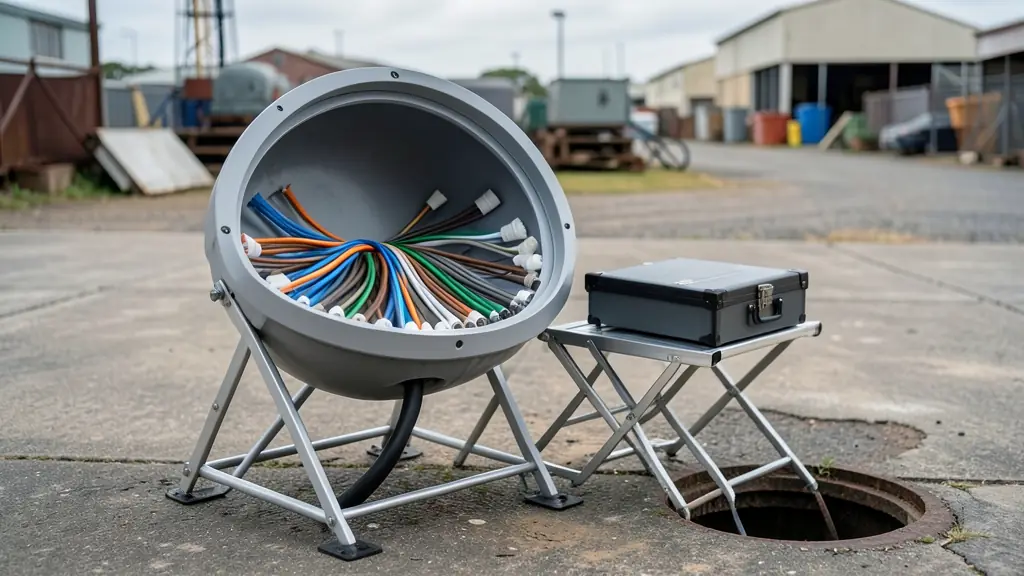
Fibre optic splicing joins two fibres so light passes from one to the other with as little loss as possible. Most work today is fusion splicing: the glass is cleaved flat, aligned in a splicer and welded with an electric arc. Splicing happens wherever cable lengths meet, at the panels at each end of a link, at closures where a cable branches, and on every repair. This page explains how splicing is done, what loss to expect, the colour code, how splicing is priced and what to have ready for the splicing team. Send one request and splicing teams near you quote directly.
Fusion and mechanical splicing
For a fusion splice, each fibre is stripped of its coating, cleaned, cleaved with a precision cleaver and placed in the fusion splicer, which aligns the two ends and fuses them with an arc. A heat-shrink splice protection sleeve, often 40 or 60 mm, goes over the joint and the fibre is laid in a splice tray. Core alignment splicers give the lowest loss for backbones and long routes; cladding alignment splicers are fine for FTTH and drops. Ribbon splicers join 12 fibres at once on high count ribbon cable. Mechanical splices and field-installable connectors hold the fibres in a small housing without an arc, and are used for drops and quick restorations.
Splice loss and the colour code
A good fusion splice has very low loss, often under 0.1 dB; the cabling standards allow up to 0.3 dB. The real test is an OTDR reading from both ends, averaged, because a one-way reading can show a splice as a gain or exaggerate it (see fibre testing). The common colour order for fibres in a tube, and tubes in a cable, is blue, orange, green, brown, slate, white, red, black, yellow, violet, rose and aqua. Some networks use another order, so the splicer checks the network's spec and records which fibre went where.
Where splicing is done
At the ends of a link, cable fibres are spliced to pigtails in a patch panel or wall box. Along a route, cables are joined in splice closures in manholes, handholes or on poles, where one cable can branch into several. Splicing is clean work in dirty places, so teams often work from a splicing tent or a vehicle fitted out for it. Glass offcuts go into a sharps container, and nobody looks into a fibre end: the light is invisible infrared.
How splicing is priced
Splicing is usually priced per splice, often with a minimum charge or a call-out fee, plus travel. Preparing a closure or panel, after-hours work and OTDR testing may be separate lines. Emergency splicing on a cut cable is often charged differently. Ask what the price includes before comparing quotes.
What to put in your request
- Number of splices and the cable types
- Where: panel, closure, manhole or pole
- Who supplies closures, trays and pigtails
- Testing needed after splicing
- Normal hours, after hours or emergency
Fibre Splicing for estates, offices, factories, mines, farms and more
- Houses and home offices: splicing a short link from the house to an outbuilding into wall boxes
- Estates, complexes and body corporates: closures and panels spliced on the estate's duct and fibre network
- Offices, business parks and shops: cable spliced to pigtails in panels at each end of a backbone
- Factories, warehouses and plants: joints on armoured links to warehouses, workshops and plant rooms
- Mines, quarries and heavy industry: splicing long underground and surface links and repairing damaged sections
- Farms, wine estates and lodges: closures on poles and joints where drums meet along a farm route
- Schools, campuses, hospitals and municipalities: panels spliced in comms rooms at schools, hospitals and campuses
- Data centres and server rooms: high count and ribbon splicing in ODFs and splice cabinets
- Network operators, ISPs and contractors: closure, cabinet and distribution point splicing for operators and ISPs
Frequently asked questions
Do you do the splicing yourselves?
What should I have ready for the splicing team?
Can a team come out the same day for a cut cable?
Is a mechanical splice as good as a fusion splice?
Fibre Splicing by province and city
- Johannesburg
- Pretoria
- Centurion
- Midrand
- Sandton
- Randburg
- Roodepoort
- Krugersdorp
- Randfontein
- Germiston
- Boksburg
- Benoni
- Kempton Park
- Alberton
- Vanderbijlpark
- Vereeniging
- Durban
- Pinetown
- Pietermaritzburg
- Richards Bay
- Newcastle
- Ladysmith
- Gqeberha (Port Elizabeth)
- East London
- Kariega (Uitenhage)
- Mthatha
- Cape Town
- Bellville
- Paarl
- Stellenbosch
- George
- Worcester
- eMalahleni (Witbank)
- Middelburg
- Secunda
- Mbombela (Nelspruit)
- Rustenburg
- Brits
- Klerksdorp
- Potchefstroom
- Mahikeng
- Polokwane
- Tzaneen
- Kimberley
- Upington
- Bloemfontein
- Welkom
- Sasolburg