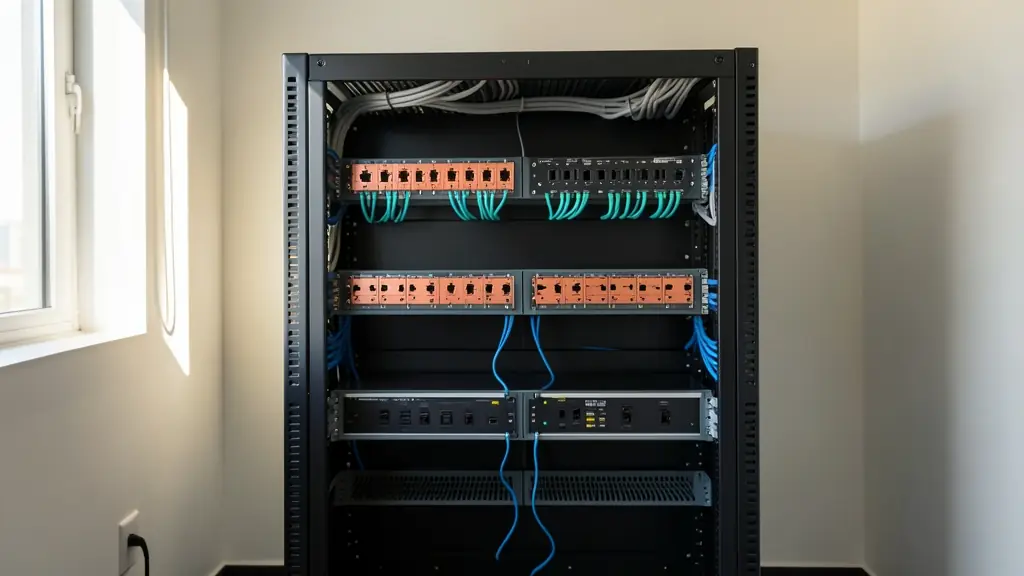
Network cabling is the fixed wiring a building's network runs on: copper cable to every desk, wireless access point and camera, fibre between floors and buildings, and the racks, panels and trays that hold it together. Done properly it is structured cabling, built to a standard, labelled and tested so it lasts through several generations of equipment. This page explains copper and fibre, what a cabling job includes and what to ask for at the end. Send one request and network cabling companies near you quote directly.
Copper to the points, fibre for the backbone
Structured cabling follows standards like ISO/IEC 11801 and TIA-568. Desks, access points and cameras get Cat6 or Cat6A copper, with a permanent link of up to 90 m from the panel to the outlet and a channel of up to 100 m with patch cords. Anything further, between floors, between buildings and to the server room, goes on fibre: multimode OM3 or OM4 inside a building, single-mode OS2 for longer runs and between buildings. Fibre between buildings also avoids the earth potential and lightning surge problems of copper.
Racks, containment and labelling
A cabling job includes the racks or cabinets, copper and fibre patch panels, cable managers, and the containment: cable trays, baskets, trunking and conduit, so cable is supported and kept away from power. Every point, port and fibre gets a label that matches a drawing or schedule. That is what lets you find a fault or move a desk years later without tracing cables by hand.
Testing and certificates
Each copper point is tested with a cable certifier against its category, and each fibre with a loss test or an OTDR trace (see fibre testing). The installer hands over test certificates per point and per fibre. When an accredited installer uses one maker's components throughout, the maker often offers a system warranty on the cabling; ask what it covers and for how long, as terms differ. Cabling is usually priced per point, with racks, backbones and containment as separate lines.
Offices, schools, warehouses and moves
Typical jobs are new office fit-outs, server room moves with new OM4 trunks and patch cords, cabling a new school block, cameras and access points across a warehouse, and replacing old Cat5e that no longer keeps up. Give the installer a floor plan with every point marked, the rack position, the ceiling and floor type, and whether the building is occupied, because working around staff after hours changes the price. On a move, ask for the old cabling to be stripped out rather than left in the ceiling, and for the new labels to follow a scheme your IT people already use.
What to put in your request
- Number of points and where they go
- Cat6 or Cat6A, and cameras or access points
- Fibre needed between floors or buildings
- Rack position and existing containment
- When the building is free to work in
Network Cabling for estates, offices, factories, mines, farms and more
- Houses and home offices: a home office, access points and gate cameras cabled to a small rack
- Estates, complexes and body corporates: cabling the gatehouse, clubhouse, cameras and estate office
- Offices, business parks and shops: points to desks, access points and printers with fibre between floors
- Factories, warehouses and plants: cameras, access points and office points across warehouses and plants
- Mines, quarries and heavy industry: control rooms, offices and workshops cabled with fibre between them
- Farms, wine estates and lodges: cabling the farm office, pack house and cameras on the gates
- Schools, campuses, hospitals and municipalities: classrooms, labs, wards and offices in schools, clinics and campuses
- Data centres and server rooms: structured cabling, trunks and patching in server rooms and suites
- Network operators, ISPs and contractors: comms rooms and points of presence for operators and wireless ISPs
Frequently asked questions
Do you install network cabling yourselves?
Cat6 or Cat6A?
When should I use fibre instead of copper?
What should I get at the end of the job?
Network Cabling by province and city
- Johannesburg
- Pretoria
- Centurion
- Midrand
- Sandton
- Randburg
- Roodepoort
- Krugersdorp
- Randfontein
- Germiston
- Boksburg
- Benoni
- Kempton Park
- Alberton
- Vanderbijlpark
- Vereeniging
- Durban
- Pinetown
- Pietermaritzburg
- Richards Bay
- Newcastle
- Ladysmith
- Gqeberha (Port Elizabeth)
- East London
- Kariega (Uitenhage)
- Mthatha
- Cape Town
- Bellville
- Paarl
- Stellenbosch
- George
- Worcester
- eMalahleni (Witbank)
- Middelburg
- Secunda
- Mbombela (Nelspruit)
- Rustenburg
- Brits
- Klerksdorp
- Potchefstroom
- Mahikeng
- Polokwane
- Tzaneen
- Kimberley
- Upington
- Bloemfontein
- Welkom
- Sasolburg