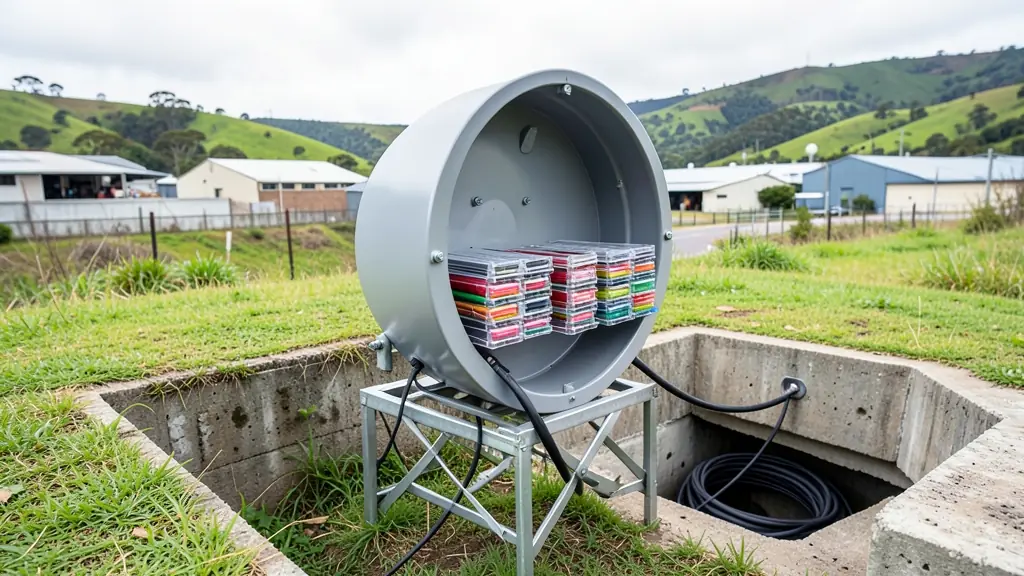
A fibre splice closure (a joint closure) is the sealed housing that protects fibres where two cables are spliced together outdoors: where drums meet on a long route, where a branch cable leaves the main one, or where a cut cable is repaired. Inside, splice trays hold the fusion splices and the fibre slack; outside, the shell and its seals keep out water, dust, insects and roots. Closures go in manholes and handholes, on poles and in the ground. The right one depends on the cables, the splices and where it will live.
Dome and inline closures
A dome closure stands upright: all the cables enter through ports in the base and a dome-shaped cover clamps over the trays. Domes suit manholes, pedestals and poles, and they are easy to re-enter because the trays lift out together. An inline closure lies flat, with cables entering at one or both ends, and fits along a cable in a narrow pit, a trench or on an aerial route. Both come in sizes set by the number of cable ports and the number of splice trays they hold. Trays often take 12 or 24 splices each, so a closure where a 96 core cable is joined straight through needs room for four to eight trays.
Sealing and protection
Closures are sealed either with heat shrink sleeves at each cable port or with mechanical seals (gel or rubber grommets and clamps). Mechanical seals are quicker to re-enter and need no flame in a manhole; heat shrink is cheap and reliable when done properly. Many closures are rated IP68 against dust and water, which matters in pits that flood after summer storms. The cable strength members and any armour are clamped inside and, where the network spec asks, bonded and earthed. One badly sealed spare port can let a closure fill with water, so unused ports keep their blanking plugs.
In manholes, on poles and buried
In a manhole or handhole, the closure is fixed to the wall or a bracket, with a coil of slack cable on each side so it can be lifted out and opened on a trestle. On a pole, it is mounted on a bracket with the slack on a storage bracket and the down-lead clamped, as high as the pole owner allows, away from where a veld fire would reach it. A buried closure needs a rating for direct burial and a record of its position. Mid-span access closures let a splicer open one tube in a running cable and drop off a few fibres without cutting the rest. See aerial fibre cable and ducts and microducts.
What a closure quote should cover
Give the supplier the cable diameters and fibre counts at each joint, how many fibres are spliced and how many pass through uncut, and where the closure goes. Ask for the trays, sleeves, port seals and mounting kit to be included, not sold separately later. If a splicing team is fitting it, the quote should list the closures, the splices, the slack loops and an OTDR test after closing, so you know packing the closure did not put a tight bend in a fibre.
What to put in your request
- Cable counts and diameters at each joint
- Splices now and branches planned later
- Manhole, pole or buried location
- Heat shrink or mechanical sealing
- Fitting, splicing and OTDR test needed or not
Fibre Splice Closures for estates, offices, factories, mines, farms and more
- Houses and home offices: rarely, only where a long buried link to a cottage or gate joins two lengths of cable
- Estates, complexes and body corporates: dome closures in handholes where street cables branch off to clusters of homes
- Offices, business parks and shops: closures in business park manholes joining building links to the campus backbone
- Factories, warehouses and plants: closures in plant manholes and cable pits joining links between workshops and stores
- Mines, quarries and heavy industry: rugged closures in pits and on poles along long armoured links across the mine
- Farms, wine estates and lodges: closures on poles and in pits where farm road routes branch to sheds and pumps
- Schools, campuses, hospitals and municipalities: closures in campus manholes joining links between school, hospital and office blocks
- Data centres and server rooms: closures in entrance manholes where outside cables meet the building cables
- Network operators, ISPs and contractors: dome closures at drum joints and branches along backbone, pole and FTTH routes
Frequently asked questions
How do I choose the size of a splice closure?
Can a splice closure be opened again?
Why did my closure fill with water?
Do you supply or fit splice closures yourselves?
Fibre Splice Closures by province and city
- Johannesburg
- Pretoria
- Centurion
- Midrand
- Sandton
- Randburg
- Roodepoort
- Krugersdorp
- Randfontein
- Germiston
- Boksburg
- Benoni
- Kempton Park
- Alberton
- Vanderbijlpark
- Vereeniging
- Durban
- Pinetown
- Pietermaritzburg
- Richards Bay
- Newcastle
- Ladysmith
- Gqeberha (Port Elizabeth)
- East London
- Kariega (Uitenhage)
- Mthatha
- Cape Town
- Bellville
- Paarl
- Stellenbosch
- George
- Worcester
- eMalahleni (Witbank)
- Middelburg
- Secunda
- Mbombela (Nelspruit)
- Rustenburg
- Brits
- Klerksdorp
- Potchefstroom
- Mahikeng
- Polokwane
- Tzaneen
- Kimberley
- Upington
- Bloemfontein
- Welkom
- Sasolburg