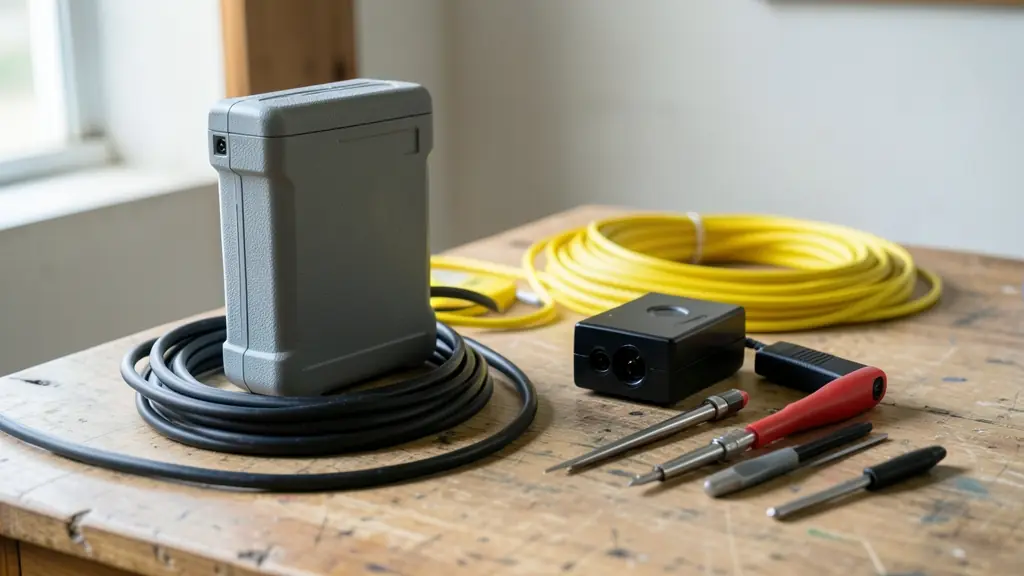
An OTDR (optical time-domain reflectometer) sends pulses of light down a fibre and measures what comes back, building a trace that shows every splice, connector, bend and break and the distance to each one. With a power meter and light source, a visual fault locator, an inspection probe and cleaning tools, it makes up the test kit every fibre contractor needs. Whether you want to buy an OTDR, find a used OTDR tester for sale in South Africa, hire one for a job or have yours calibrated, here is what the specifications mean and how to compare quotes.
What an OTDR shows
The trace falls steadily along the fibre, with steps at splices, spikes at connectors and a sharp end where the fibre ends or breaks. Testing at 1310 and 1550 nm covers most single-mode work, and comparing the two helps show up bends. For live PON fibres, an OTDR at 1625 or 1650 nm tests through a filter without disturbing the customers. Multimode testing uses 850 and 1300 nm. Bidirectional testing from both ends, averaged, gives the true loss of each splice. The OTDR is also the tool for finding a break: it gives the distance, and the crew measures along the route to find where to dig.
Specifications that matter
Dynamic range, in dB, is how much loss the OTDR can see through, so it decides how long a route it can test. Dead zones are the lengths after a reflective event where it cannot see: the event dead zone decides whether it can separate two connectors close together, and the attenuation dead zone is where it can measure loss again. Short dead zones matter in buildings and FTTH; high dynamic range matters on long routes. Pulse width, range and averaging time trade detail against distance. Launch and receive fibres, leads of a few hundred metres to a couple of kilometres, let the OTDR measure the first and last connectors on the link.
The rest of the test kit
- Optical power meter and light source (an OLTS or loss test set): measures the end-to-end loss for Tier 1 testing against the loss budget.
- Visual fault locator (VFL): a red 650 nm laser that shows breaks and tight bends over short distances and traces fibres in a panel.
- Fibre inspection probe: a microscope that checks connector end faces against IEC 61300-3-35, used with cleaning tools, because dirty connectors cause most high loss.
- Fibre identifiers and talk sets for finding live fibres and working between two ends.
See fibre testing for how a full test and report are done.
Buying, hiring and calibration
OTDRs and power meters can be bought new, bought used or hired by the day or week, and a testing contractor can bring the whole kit. OTDR prices depend on the wavelengths, dynamic range, dead zones and software, so compare quotes for the same configuration and accessories. On a used OTDR, ask for the calibration certificate, its age and use, the condition of its test port and a sample trace on a known fibre. All test gear needs regular calibration; ask the supplier or a calibration workshop for the interval the maker sets.
What to put in your request
- Buy new, buy used, hire or calibrate
- Single-mode, multimode or PON testing
- Route lengths and type of work
- Launch fibres, VFL and probe needed or not
- Software and report format wanted
OTDR and Fibre Test Equipment for estates, offices, factories, mines, farms and more
- Houses and home offices: not needed at home, as an installer tests a private link with their own kit
- Estates, complexes and body corporates: used by the estate's contractor to test new drops and find faults
- Offices, business parks and shops: brought in by the cabling installer to certify fibre backbones
- Factories, warehouses and plants: kept by some plants' maintenance departments, or hired for audits
- Mines, quarries and heavy industry: kept on many mines to find breaks on long links quickly
- Farms, wine estates and lodges: brought by the contractor to test and fault-find farm links
- Schools, campuses, hospitals and municipalities: used by campus cabling contractors for acceptance testing
- Data centres and server rooms: short dead zone OTDRs and inspection probes for dense patching and MPO links
- Network operators, ISPs and contractors: OTDRs in every operator and wireless ISP van for builds and repairs
Frequently asked questions
What is an OTDR test?
How much does an OTDR cost?
Where can I get an OTDR calibrated?
Do you sell, hire out or test with OTDRs yourselves?
OTDR and Fibre Test Equipment by province and city
- Johannesburg
- Pretoria
- Centurion
- Midrand
- Sandton
- Randburg
- Roodepoort
- Krugersdorp
- Randfontein
- Germiston
- Boksburg
- Benoni
- Kempton Park
- Alberton
- Vanderbijlpark
- Vereeniging
- Durban
- Pinetown
- Pietermaritzburg
- Richards Bay
- Newcastle
- Ladysmith
- Gqeberha (Port Elizabeth)
- East London
- Kariega (Uitenhage)
- Mthatha
- Cape Town
- Bellville
- Paarl
- Stellenbosch
- George
- Worcester
- eMalahleni (Witbank)
- Middelburg
- Secunda
- Mbombela (Nelspruit)
- Rustenburg
- Brits
- Klerksdorp
- Potchefstroom
- Mahikeng
- Polokwane
- Tzaneen
- Kimberley
- Upington
- Bloemfontein
- Welkom
- Sasolburg