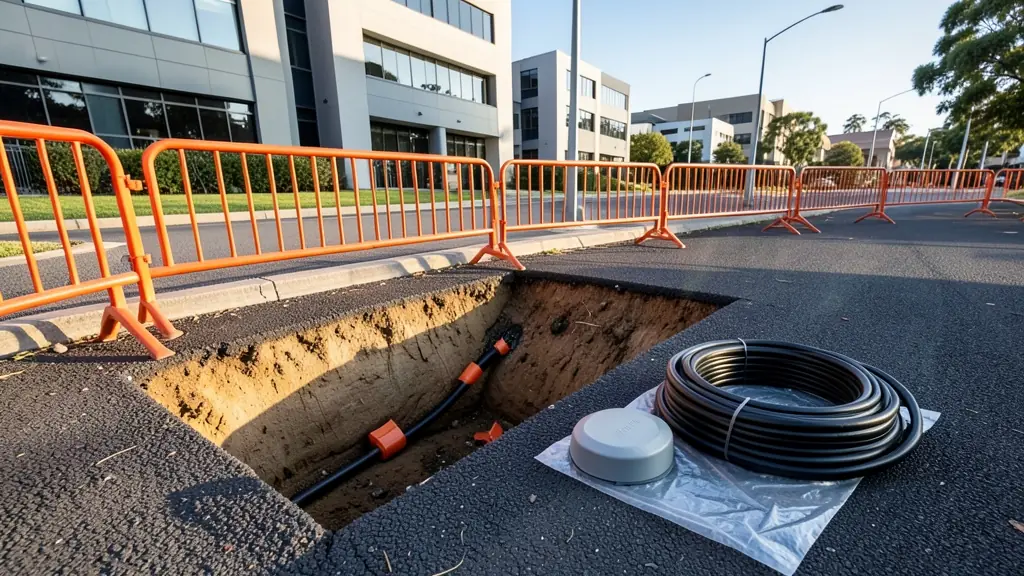
A fibre cable repair usually starts with a phone call: the cameras are down, the warehouse has no network, or a contractor has just pulled a black cable out of a trench. The fix follows the same steps every time. An OTDR shows how far along the cable the break is, the crew finds it on the ground, digs it out and either splices the cable in a new closure or replaces a section. Then they test it. This page explains the causes, the repair, what it involves and the evidence to keep. Send one request and repair crews near you quote directly.
What breaks fibre
The most common cause is digging: other contractors, roadworks and new services going in. After that come vandalism and theft (thieves sometimes cut fibre believing it is copper), rodents and termites on unarmoured cable, veld fires burning under aerial routes, storm and wind damage to spans, vehicles hitting poles, water getting into closures, and tight bends or crushed cable in old installations. Inside buildings, the fault is often a damaged patch cord, a broken connector or a dirty end face, which is a much smaller job.
Finding the break
The crew connects an OTDR at the nearest panel and reads the distance to the break. That is the distance along the fibre, which includes slack loops and the cable's own extra length inside its tubes, so the crew walks or measures the route with the as-built drawings to find the spot. Often it is obvious: a fresh trench or a burnt pole. A visual fault locator finds breaks close to the panel. Without as-builts the search takes longer, which is one reason to insist on them at installation.
Restoring and repairing
Where there is enough slack, the two ends are spliced in a new splice closure. Where there is not, or a length is damaged, a new section of cable goes in with two closures, one at each end. On a critical link the crew may do an emergency restoration first, splicing the fibres that carry traffic, and the permanent repair later. A damaged duct is replaced or sleeved, and the route reinstated. Every repaired fibre should be tested and the result recorded.
Keep the evidence
If someone else damaged the cable, keep photos of the damage and the site, the OTDR trace before and after, and the repair report with the date and cost. You will need them for an insurance claim or a claim against whoever dug it up. Ask the repair contractor for a written report that names the cause where it is clear, the length of cable replaced, the closures fitted and the test results.
What to put in your request
- What happened and when it was noticed
- Cable type, core count and route length
- Where the fault seems to be
- Whether you have as-built drawings
- How urgent the repair is
Fibre Optic Cable Repairs for estates, offices, factories, mines, farms and more
- Houses and home offices: a link to an outbuilding chewed by rats or cut while digging a garden
- Estates, complexes and body corporates: estate fibre cut by a contractor laying water pipes or paving
- Offices, business parks and shops: a business park link cut by roadworks or new services
- Factories, warehouses and plants: armoured links damaged by machinery, forklifts or new foundations
- Mines, quarries and heavy industry: cables crushed or cut by heavy equipment and blasting work
- Farms, wine estates and lodges: aerial spans burnt by veld fires or buried cable dug up by a tractor
- Schools, campuses, hospitals and municipalities: a school or hospital link damaged during building work
- Data centres and server rooms: damaged trunks, patch cords and connectors in racks and trays
- Network operators, ISPs and contractors: cut backbone and distribution cables restored for operators and ISPs
Frequently asked questions
Do you repair fibre yourselves?
How quickly can a cut cable be repaired?
My home internet is down. Can you help?
How do I stop it happening again?
Fibre Optic Cable Repairs by province and city
- Johannesburg
- Pretoria
- Centurion
- Midrand
- Sandton
- Randburg
- Roodepoort
- Krugersdorp
- Randfontein
- Germiston
- Boksburg
- Benoni
- Kempton Park
- Alberton
- Vanderbijlpark
- Vereeniging
- Durban
- Pinetown
- Pietermaritzburg
- Richards Bay
- Newcastle
- Ladysmith
- Gqeberha (Port Elizabeth)
- East London
- Kariega (Uitenhage)
- Mthatha
- Cape Town
- Bellville
- Paarl
- Stellenbosch
- George
- Worcester
- eMalahleni (Witbank)
- Middelburg
- Secunda
- Mbombela (Nelspruit)
- Rustenburg
- Brits
- Klerksdorp
- Potchefstroom
- Mahikeng
- Polokwane
- Tzaneen
- Kimberley
- Upington
- Bloemfontein
- Welkom
- Sasolburg