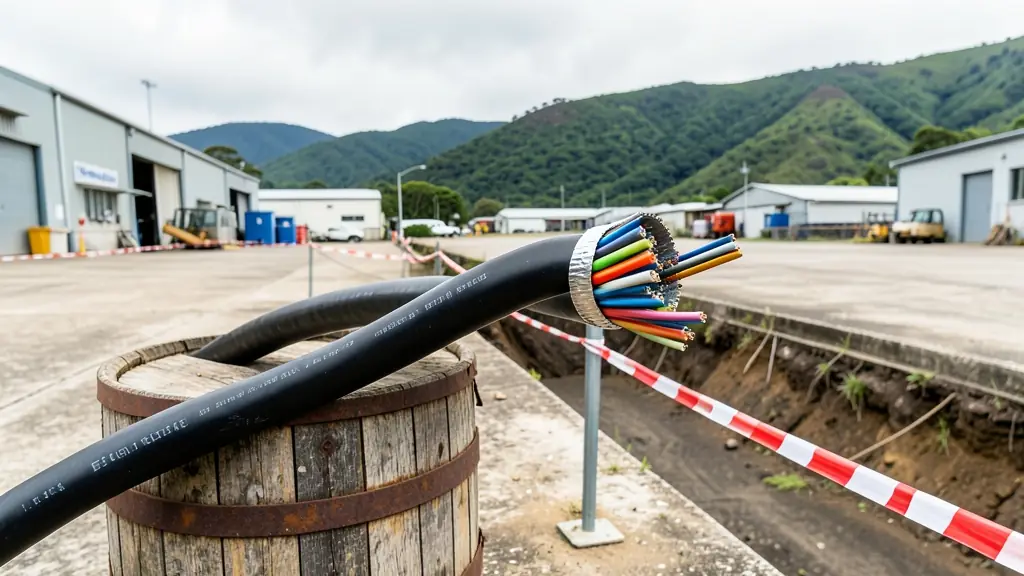
Rats, termites, sharp stones and the next contractor's spade are the main enemies of buried fibre. Armoured fibre cable puts a layer of steel or glass yarn under the outer jacket so that the tubes and fibres inside survive what plain cable does not. It is the usual choice for direct burial, for long links across factories, mines and farms, and for routes through bushveld where termites are a known problem. This page covers the armour types, where each suits, earthing, the extra weight and bend radius, and what a supplier needs to quote.
Steel tape, steel wire or glass yarn
- Corrugated steel tape (CST): a ribbed steel layer under the jacket. The common choice for rodent protection and burial in duct or direct.
- Steel wire armour: steel wires laid around the cable, for heavier mechanical protection and higher pulling loads.
- Non-metallic rodent protection: glass yarns that deter chewing without any metal, so no earthing is needed. Useful near power lines or where metal is unwanted.
Most armoured cable is loose tube single-mode with a black polyethylene jacket. Ask whether the tubes are gel-filled or dry and water-blocked: dry cable is cleaner to work with in a closure.
Direct burial or in duct
Armoured cable can be buried straight in a trench with warning tape above it, which saves the cost of duct on a long rural or mine route. In duct it adds protection where rodents get into pipes. Direct burial makes later repairs and upgrades harder, so many owners still lay ducts on busy sites. The trench depth, the warning tape and the separation from power cables come from the municipality's wayleave conditions or the site's own spec, not from a rule of thumb: see fibre trenching.
Earthing, weight and bend radius
Metal armour must be earthed at the ends, usually in the panel or closure, so that it cannot carry a surge into equipment. Ask the installer how it will be done. Armoured cable is heavier and stiffer than plain cable, so its minimum bend radius is larger and it needs more care on the drum and at building entries. The datasheet gives the bend radius and the maximum pulling tension; a good installer works within both. Leave slack loops in handholes for future repairs.
Factories, mines and farms
On a factory site, armoured cable links a new warehouse or a gatehouse a few hundred metres away. On mines it runs between shafts, plants and the control room, where vehicles, rock and digging are constant. On farms and game lodges it crosses open ground to pump houses, cellars and gates through rodent and termite country. For a link to a single building, a supplier needs the length, core count and armour type; for the whole job, add installation and testing.
What to put in your request
- The route length and the ground type
- Direct burial or in duct
- Steel tape, steel wire or non-metallic armour
- The core count, with spares
- Whether trenching and splicing are needed too
Armoured Fibre Optic Cable for estates, offices, factories, mines, farms and more
- Houses and home offices: a buried run across a large garden or plot to an outbuilding or gate
- Estates, complexes and body corporates: perimeter links to gatehouse cameras and security towers through open ground
- Offices, business parks and shops: links between buildings on a business park where ducts are rodent-prone
- Factories, warehouses and plants: buried links between factory buildings, warehouses and yards
- Mines, quarries and heavy industry: rugged links between shafts, plants, workshops and control rooms
- Farms, wine estates and lodges: long buried runs through termite country to pump houses and cellars
- Schools, campuses, hospitals and municipalities: campus links between school blocks and hospital buildings
- Data centres and server rooms: entry cables from the street into the building's meet-me room
- Network operators, ISPs and contractors: rural and backbone routes through rocky or rodent-prone ground
Frequently asked questions
Do you supply or lay armoured cable yourselves?
No. We pass your request on to independent cable suppliers, fibre installers and civil contractors in your area, who quote you directly. We do no supply or installation work ourselves.
Does armour stop a digger?
No cable survives a digger bucket. Armour resists rodents, termites, stones and the odd spade. Warning tape, accurate as-built drawings and marker posts do more to stop accidental digging than any armour.
Is armoured cable much more expensive?
It costs more per metre than plain cable and the price rises with the core count and armour type. On a direct burial route it can save the cost of duct. Ask suppliers to price armoured and ducted options side by side, including the civils, because the trench usually costs more than the cable.
Can I run armoured cable indoors?
Usually it is spliced to indoor cable or pigtails in a closure or panel near the building entry, because the outdoor jacket may not meet indoor fire requirements. Ask the installer what the building calls for.
Armoured Fibre Optic Cable by province and city
- Johannesburg
- Pretoria
- Centurion
- Midrand
- Sandton
- Randburg
- Roodepoort
- Krugersdorp
- Randfontein
- Germiston
- Boksburg
- Benoni
- Kempton Park
- Alberton
- Vanderbijlpark
- Vereeniging
- Durban
- Pinetown
- Pietermaritzburg
- Richards Bay
- Newcastle
- Ladysmith
- Gqeberha (Port Elizabeth)
- East London
- Kariega (Uitenhage)
- Mthatha
- Cape Town
- Bellville
- Paarl
- Stellenbosch
- George
- Worcester
- eMalahleni (Witbank)
- Middelburg
- Secunda
- Mbombela (Nelspruit)
- Rustenburg
- Brits
- Klerksdorp
- Potchefstroom
- Mahikeng
- Polokwane
- Tzaneen
- Kimberley
- Upington
- Bloemfontein
- Welkom
- Sasolburg