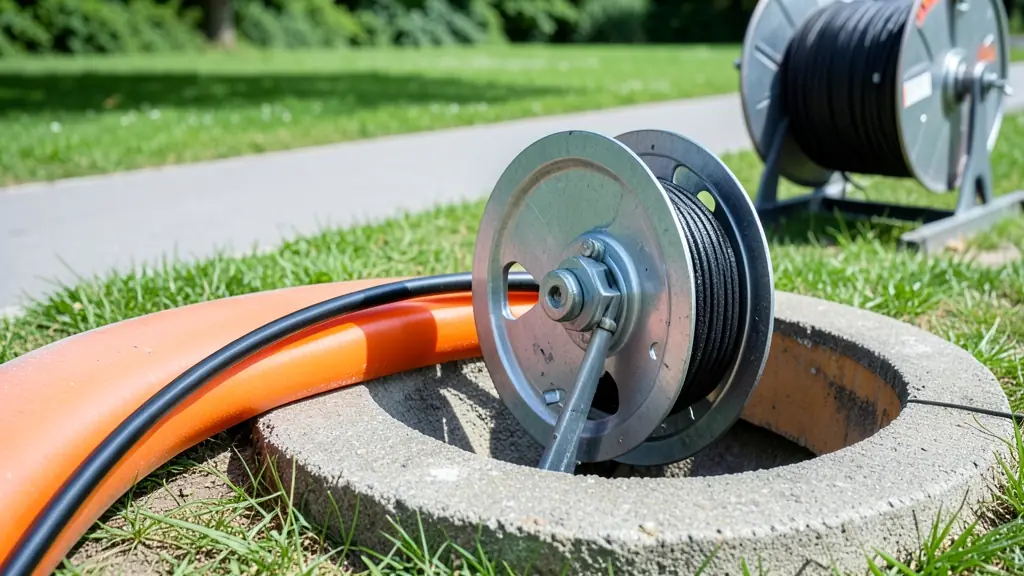
Bend a fibre cable too tightly and light leaks out of the glass. A tight bend can add loss at once, or crack the fibre later. The safe radius depends on the cable's diameter while it is pulled and once it is in place, and on the grade of fibre when bare fibre is coiled in a box or a tray.
The rule of thumb
Unless the datasheet says otherwise, the TIA cabling standard's rule is a bend radius of at least 20 times the cable's outside diameter while it is being pulled, and 10 times once it is fixed with no load on it. Small indoor cables of 2 to 4 fibres may bend to a 50 mm radius under tension and 25 mm without. The cable datasheet always takes precedence: armoured and ribbon cables can need more.
Radius is from the centre of the curve to the cable; the diameter of the loop is twice that. A 12 mm cable needs a 240 mm radius while pulling, so pulling sheaves, duct bends and the throat of a handhole must be at least that big. See fibre installation and ducts and microducts.
Bend insensitive fibre
Standard single-mode fibre (G.652.D) is usually kept to a 30 mm radius in splice trays. Bend insensitive fibre to ITU-T G.657 tolerates far tighter bends: about 10 mm radius for G.657.A1, 7.5 mm for A2 and B2, and 5 mm for B3. That is why FTTH drop cables and indoor cords use it: they are stapled round door frames and coiled in small wall boxes. The cable round the fibre still has its own limit.
Signs a bend is too tight
Extra loss at 1550 nm or 1625 nm but not at 1310 nm is the classic sign of a tight bend, because longer wavelengths leak first. An OTDR shows a loss step with no reflection at the bend, and a visual fault locator lights it up red. Free it, re-dress it round a larger curve and test again. See fibre testing and certification.
A guide, not a design
These figures follow the published standards and common design values, and the calculators work in your browser. They are a guide for planning and checking quotes. The datasheets for your cable and optics, and the network designer or contractor, have the final word. Nothing you type here is sent anywhere.