
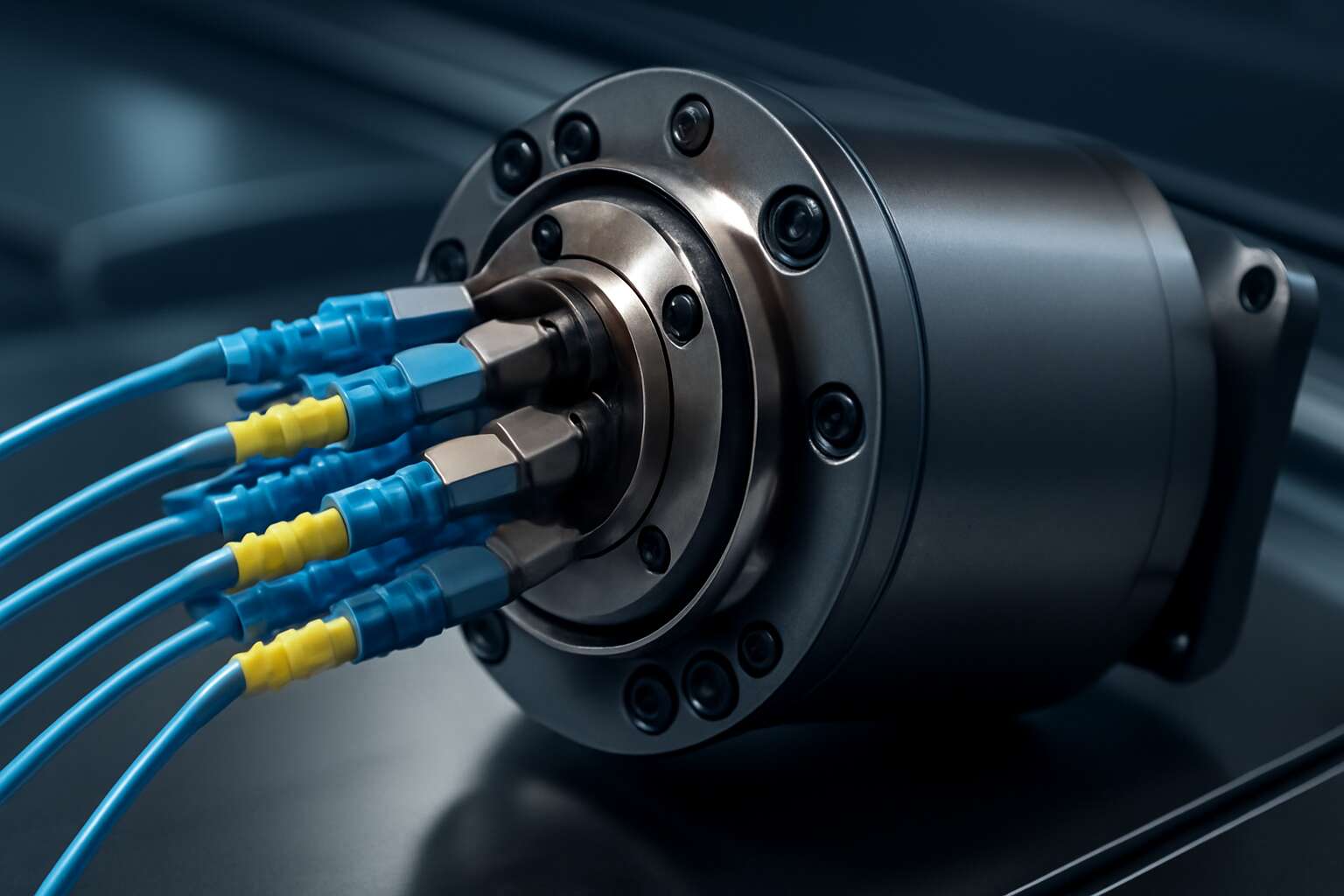
Understanding Fibre Optic Rotary Joints
Definition and Basic Functionality
Imagine a device that seamlessly connects spinning machinery with delicate data signals, allowing information to flow as effortlessly as a whispering wind. The fibre optic rotary joint stands as a marvel of modern engineering—an invisible bridge that transmits high-speed data across rotating interfaces without interruption. Its fundamental purpose is to enable continuous communication, even as components turn and twist with relentless precision. At its core, a fibre optic rotary joint is designed to maintain the integrity of the fibre optic signal, preventing loss or degradation that could compromise performance.
These intricate devices operate on a principle as elegant as a ballet, ensuring that the fibre optic signals remain stable amidst constant motion. They are vital in applications ranging from military radar systems to satellite communications, where the need for uninterrupted data transfer is paramount. The basic functionality involves aligning the fibre cores within the joint, allowing light signals to pass through without interruption or distortion. This delicate dance of light and motion makes the fibre optic rotary joint an essential component in the world of high-speed data transfer and advanced automation.
Traditional vs. Fibre Optic Rotary Joints
Traditional rotary joints have served industries well for decades, relying on metal or glass slip rings to transmit signals across rotating interfaces. While effective for electrical signals, they often face limitations when handling high-speed data transfer or delicate fibre optic signals. This is where the fibre optic rotary joint (FORJ) shines, offering a leap forward in performance and reliability.
A fibre optic rotary joint is designed specifically to transmit light signals without degradation, even during continuous rotation. Unlike traditional rotary joints, FORJs minimise signal loss and maintain high data integrity over long operational periods. Their specialised design ensures that light signals pass seamlessly through the rotating interface, avoiding the interference or noise common with electrical counterparts.
Key differences include:
- Fibre optic rotary joints support higher bandwidths and faster data rates.
- They are less susceptible to electromagnetic interference, making them ideal for sensitive applications.
- FORJs are often more durable and require less maintenance compared to traditional rotary joints.
In essence, fibre optic rotary joints are a game-changer for industries demanding high-speed, reliable data transfer across rotating systems. Their unique ability to maintain signal integrity sets them apart from traditional solutions, making them the preferred choice in modern automation and communication systems.
Importance in Modern Industries
In today’s fast-evolving technological landscape, industries are increasingly dependent on seamless data transmission across rotating systems. The importance of a fibre optic rotary joint cannot be overstated, especially when high-speed, reliable communication is vital. These advanced components enable organisations to maintain optimal performance in demanding environments, where traditional solutions often fall short.
Fibre optic rotary joints are crucial for applications such as aerospace, defence, and large-scale manufacturing. Their ability to transmit light signals with minimal loss ensures that sensitive data remains intact even during continuous rotation. This resilience not only boosts operational efficiency but also enhances safety and system longevity. For industries that rely on real-time data exchange, the fibre optic rotary joint is a dependable backbone, supporting complex automation and communication networks.
Choosing the right fibre optic rotary joint involves understanding key features such as durability, bandwidth capacity, and ease of maintenance. The technology’s capacity to support higher bandwidths and faster data rates makes it an indispensable tool for modern industries, helping them stay ahead in a fiercely competitive market.
Key Components and Working Principles
Core Components of Fibre Optic Rotary Joints
At the heart of every fibre optic rotary joint lies a symphony of intricate components, each playing a vital role in maintaining pristine signal fidelity amidst relentless rotation. These core components are engineered with precision, ensuring that the delicate dance of light transmission remains uninterrupted, regardless of motion or environmental stress. The primary elements include the optical fibres themselves, which are delicately aligned within specialised couplings, and the rotational mechanism that allows for seamless movement without signal loss.
Understanding the working principles of a fibre optic rotary joint reveals a marvel of optical engineering. Light signals are transmitted through the fibre cores, which are carefully housed to minimise loss and reflection. As the joint rotates, the optical interface remains aligned, allowing signals to pass through with minimal attenuation. This process is akin to a lighthouse beam, continuously shining through a rotating lens—precise, unwavering, and remarkably efficient. The entire operation hinges on maintaining optimal core alignment, often achieved through sophisticated optical and mechanical design.
- High-precision optical couplers
- Robust rotational mechanism
- Minimal insertion loss
- High durability for demanding environments
How They Transmit Light Signals
Within the realm of fibre optic rotary joints, the magic lies in the seamless transmission of light signals through a meticulously crafted symphony of components. The core of this marvel involves high-precision optical couplers, which serve as the enchanted bridges guiding light with unwavering accuracy. These couplers are designed to maintain optimal core alignment, ensuring that light passes through without loss or reflection, even amidst relentless rotation.
At the heart of the operation is a robust rotational mechanism that allows for smooth, continuous movement. This mechanical dance is engineered to withstand environmental stressors, preserving signal integrity over countless revolutions. The entire process is a testament to optical engineering prowess, where each element works in harmony to ensure minimal insertion loss and high durability, making the fibre optic rotary joint an indispensable component in demanding industrial applications.
- The optical fibres themselves are delicately aligned within specialised couplings, acting as conduits for light transmission.
- The rotational mechanism maintains precise interface alignment, preventing signal degradation during motion.
- Specialised coatings and housings minimise reflection, ensuring the signal remains pure and strong.
Altogether, these key components operate as a finely tuned orchestra, enabling the fibre optic rotary joint to deliver unparalleled performance in environments where reliability and precision are paramount.
Design Features Ensuring Signal Integrity
In the intricate ballet of a fibre optic rotary joint, every component plays a pivotal role in sustaining the delicate dance of light transmission. At the core of this marvel are high-precision optical couplers, which act as the enchanted bridges ensuring unwavering core alignment. These couplers are meticulously engineered to prevent signal loss and reflection, even as the joint endures relentless rotation. Their specialised coatings and housings further minimise internal reflection, preserving the purity of the transmitted light signal.
Ensuring optimal performance requires a rotational mechanism that combines robustness with finesse. This mechanism maintains exact interface alignment, preventing signal degradation during continuous motion. It’s a feat of optical engineering mastery, where mechanical precision meets optical excellence. The design features of a fibre optic rotary joint are thus geared towards delivering high durability and minimal insertion loss, vital for demanding industrial environments.
In essence, the operation of a fibre optic rotary joint is akin to a finely tuned orchestra, with each element working harmoniously to uphold signal integrity. Whether in aerospace, military, or industrial sectors, these components are indispensable — a testament to the relentless pursuit of reliability and precision in optical communication technology.
Types of Fibre Optic Rotary Joints
Single-Channel vs. Multi-Channel Rotary Joints
When it comes to fibre optic rotary joints, understanding the difference between single-channel and multi-channel designs is crucial for selecting the right component for your application. The choice impacts not only signal capacity but also reliability and complexity. Single-channel fibre optic rotary joints are straightforward and ideal for systems where only one data stream is necessary. They offer simplicity and cost-effectiveness, making them popular in less demanding environments.
On the other hand, multi-channel fibre optic rotary joints are engineered for high-performance scenarios. These allow multiple signals to pass through simultaneously, significantly increasing bandwidth and operational flexibility. The design complexity of multi-channel units ensures they can handle more data without compromising signal integrity, which is vital in sectors like defence, aerospace, or advanced manufacturing.
- Single-channel fibre optic rotary joints excel in applications with minimal data transfer requirements.
- Multi-channel variants are suited for complex systems demanding high data throughput and redundancy.
Choosing between these types often boils down to the specific needs of your project, but understanding their distinct advantages can make a difference in ensuring seamless operation and optimal performance of your fibre optic rotary joint system.
Rotary Joint Configurations (Horizontal, Vertical, Custom)
Fibre optic rotary joints are marvels of engineering that enable seamless data transmission in rotating systems, but did you know that their configuration can dramatically influence performance? The choice between horizontal, vertical, or custom fibre optic rotary joint designs isn’t just a matter of aesthetics; it’s a strategic decision that impacts signal integrity and operational efficiency. Horizontal rotary joints are often preferred for their stability in large-scale industrial setups, allowing for easier maintenance and integration. Vertical variants, meanwhile, lend themselves well to applications where space is limited or where orientation plays a critical role. When off-the-shelf solutions don’t fit the bill, custom fibre optic rotary joints come into play, tailored precisely to meet specific environmental or technical demands. They provide flexibility and optimise performance in complex systems, such as aerospace or defence operations, where every detail counts. Whether you need a straightforward or bespoke design, understanding the different rotary joint configurations ensures your fibre optic rotary joint system functions flawlessly in even the most demanding environments.
Preferred Types for Specific Applications
Different types of fibre optic rotary joints are designed to meet specific application needs. For instance, single-channel fibre optic rotary joints are ideal for straightforward data transfer in applications like CCTV surveillance systems, where only one data stream is necessary. In contrast, multi-channel fibre optic rotary joints excel in complex environments such as military or aerospace, transmitting multiple signals simultaneously without interference.
Choosing the right fibre optic rotary joint depends on the operational environment. Horizontal rotary joints suit large industrial setups, offering stability and ease of maintenance. Vertical variants are often preferred when space is limited or orientation matters. Custom fibre optic rotary joints, however, are tailored for demanding environments—think high-vibration or extreme temperature conditions—ensuring robust performance where off-the-shelf solutions fall short.
Understanding the specific demands of your application helps determine the optimal type of fibre optic rotary joint. Whether you need a simple, reliable design or a sophisticated, multi-channel system, selecting the correct configuration can significantly boost signal integrity and operational efficiency. After all, a well-chosen fibre optic rotary joint is crucial for flawless data transmission in even the most challenging environments.
Applications of Fibre Optic Rotary Joints
Military and Defense
In the high-stakes realm of military and defence, where precision and reliability are paramount, fibre optic rotary joints (FORJs) have become indispensable. These sophisticated components enable seamless data transmission in rotating systems, ensuring secure and rapid communication even amidst the chaos of battlefield manoeuvres. With the ability to transmit encrypted signals across complex, spinning platforms, fibre optic rotary joints offer a level of versatility that traditional solutions simply cannot match.
Applications within military platforms are as diverse as they are critical. From radar systems and missile launchers to naval vessels and airborne surveillance, the fibre optic rotary joint acts as the silent conductor, orchestrating data flow with impeccable timing. The unique capability of FORJs to support multi-channel configurations means they can handle multiple data streams simultaneously, a crucial feature for modern defence systems that demand real-time intelligence and coordination.
- Enhanced security through encrypted light signals
- Robust performance in extreme environmental conditions
- Support for multi-channel data transmission in complex systems
In essence, fibre optic rotary joints elevate military technology, transforming rotating components from potential weak links into fortresses of connectivity. As defence architectures continue to evolve, the strategic importance of these devices becomes ever more apparent, safeguarding operational integrity with uncompromising finesse.
Aerospace and Satellite Technology
In the vast expanse of aerospace and satellite technology, fibre optic rotary joints (FORJs) serve as the silent maestros orchestrating communication across spinning platforms. These devices are not merely components; they are the lifelines that connect the celestial with the terrestrial, ensuring that data flows seamlessly through the cosmic ballet of satellites and aircraft. With the ability to support multiple data streams simultaneously, FORJs are essential for maintaining the integrity of complex systems where timing and precision are everything.
Applications of fibre optic rotary joints in this domain are as diverse as the stars themselves. From stabilising high-resolution imaging systems in satellites to enabling real-time communication in airborne platforms, these joints facilitate a dance of light and information that is both elegant and resilient. Their robust design ensures they withstand the extreme environmental conditions of space and high-altitude flight, where temperature fluctuations and radiation pose significant challenges.
Specifically, fibre optic rotary joints in aerospace and satellite technology often feature:
- Multi-channel configurations for transmitting extensive data loads
- Enhanced environmental sealing to protect delicate optical signals
- Customised designs to fit unique platform geometries and operational requirements
As the universe expands with technological innovation, the importance of fibre optic rotary joints in satellite and aerospace applications continues to grow. They are the invisible threads weaving connectivity into the fabric of modern exploration, ensuring that vital information remains unbroken even amidst the spinning chaos of space and high-altitude missions.
Medical Equipment and Diagnostics
In the shadowed corridors of modern medicine, the fibre optic rotary joint emerges as an unsung hero, weaving a delicate ballet of light and data within diagnostic marvels. These intricate devices quietly support high-precision imaging systems, where even the slightest disruption could distort the truth captured beneath the surface. Their ability to transmit multiple signals simultaneously ensures that complex medical equipment functions with unerring accuracy, safeguarding the integrity of vital data.
From advanced MRI machines to sophisticated endoscopic tools, fibre optic rotary joints serve as the pivotal link that maintains flawless communication between rotating components and stationary systems. This seamless transfer of light signals is paramount when dealing with sensitive diagnostics, where clarity and reliability are paramount. Their resilient design withstands the sterilisation processes and environmental rigours of medical environments, ensuring longevity and steadfast performance.
In such a delicate domain, the importance of a robust fibre optic rotary joint cannot be overstated. It is the silent guardian of precision—ensuring that the flow of information remains unbroken in a realm where every photon counts. Whether in high-resolution imaging or real-time monitoring, these devices are the unseen threads that bind the fabric of medical innovation.
Industrial Automation and Machinery
In the realm of industrial automation and machinery, the role of the fibre optic rotary joint is nothing short of transformative. These sophisticated devices enable seamless communication between rotating parts and stationary systems, ensuring high-speed data transfer without interruption. From robotic arms in manufacturing plants to complex assembly lines, fibre optic rotary joints facilitate real-time monitoring and control, vital for maintaining operational efficiency.
Industries that rely heavily on precision and reliability benefit immensely from multi-channel fibre optic rotary joints, which can transmit numerous signals simultaneously. This capability helps prevent data bottlenecks and ensures synchronised movements across machinery. Whether in high-speed automation lines or heavy-duty equipment, the durability and resilience of fibre optic rotary joints stand up to harsh environments and demanding operational cycles.
Applications often involve configurations tailored to specific needs, such as horizontal, vertical, or customised setups. These adaptable designs optimise performance and minimise maintenance, making fibre optic rotary joints an indispensable component in modern industrial machinery and automation systems.
Research and Scientific Instruments
In the shadowed corridors of scientific exploration, where precision meets the unknown, fibre optic rotary joints emerge as silent sentinels. Their application in research and scientific instruments unlocks realms of data transmission that once belonged to the realm of fantasy. These devices facilitate the real-time exchange of light signals in configurations that demand unwavering fidelity, even amidst the relentless dance of rotation.
In laboratories and observatories, fibre optic rotary joints serve as the conduit for complex experiments, enabling high-speed, multi-channel data transfer without loss or distortion. For instance, in astronomical telescopes, they allow for the seamless rotation of sensors and detectors while maintaining crystal-clear signal integrity. Similarly, in advanced spectroscopic instruments, fibre optic rotary joints ensure that delicate light signals traverse unbroken, capturing the universe’s secrets with unparalleled clarity.
Manufacturers often deploy specialised fibre optic rotary joints in experimental setups that require customised configurations—be they horizontal or vertical—to optimise performance. These devices are crucial in environments where reliability and resilience dictate success, transforming the way scientists observe phenomena that stretch the boundaries of human understanding.
Advantages of Using Fibre Optic Rotary Joints
High Bandwidth Transmission
In a world increasingly driven by data, high bandwidth transmission stands as the cornerstone of modern communication. The fibre optic rotary joint, with its ability to facilitate seamless optical signal transfer during rotation, offers an elegant solution to the perennial challenge of maintaining high-speed connectivity in dynamic environments. Unlike traditional connectors that risk signal degradation, fibre optic rotary joints ensure that data flows unimpeded even under demanding operational conditions.
One compelling advantage of employing a fibre optic rotary joint is its capacity for high bandwidth transmission. This means larger volumes of data—think real-time video feeds, complex sensor signals, or vast scientific datasets—can be transmitted without a hitch. Such capability proves invaluable in sectors like aerospace, military, or industrial automation, where split-second decisions hinge on rapid data exchange. The consistent performance of fibre optic rotary joints underpins the efficiency of these critical applications, making them a favourite among engineers who value both precision and speed.
Moreover, their inherent immunity to electromagnetic interference and superior durability contribute to long-term reliability. For applications demanding multi-channel data transfer, fibre optic rotary joints excel, allowing multiple signals to be transmitted simultaneously without cross-talk or signal loss. This versatility ensures that industries reliant on sophisticated, multi-faceted systems find a trusted partner in fibre optic rotary joints, turning the complex art of high bandwidth transmission into a straightforward affair.
Low Signal Loss and Interference
In the realm of high-performance communication, the fibre optic rotary joint stands as a beacon of innovation, seamlessly bridging the gap between spinning machinery and pristine data transfer. One of its most compelling advantages is its low signal loss, a critical factor for maintaining the integrity of transmitted data. Unlike traditional connectors susceptible to degradation over time, a fibre optic rotary joint ensures that optical signals remain clear and robust, even after countless rotations.
This resilience against interference is especially vital in environments rife with electromagnetic disturbances—think aerospace or military applications—where signal clarity can make the difference between success and failure. Thanks to their inherent immunity to electromagnetic interference, fibre optic rotary joints deliver consistent, high-quality performance. Their durability and reliability underpin the smooth operation of complex systems, allowing data to flow uninterrupted in the most demanding circumstances.
Durability and Market Resilience
In a world where data is king and downtime is the court jester, fibre optic rotary joints stand tall as the unsung heroes of high-tech reliability. Their durability isn’t just about withstanding the rigours of spinning machinery; it’s about ensuring that your data stream stays as smooth as silk, even when subjected to the most demanding environments. Unlike traditional connectors that are prone to corrosion and wear, the fibre optic rotary joint boasts a formidable resilience, making it a favourite among industries where reliability is non-negotiable.
Market resilience is another feather in its cap. As industries evolve and technological demands skyrocket, the fibre optic rotary joint adapts seamlessly, ensuring continuous, high-quality data transmission. From aerospace to military applications, their durability isn’t just a bonus—it’s the backbone of critical operations. Whether enduring extreme temperatures or prolonged use, a fibre optic rotary joint maintains peak performance, proving that durability and market resilience are not just buzzwords but essential features for any cutting-edge system.
Ease of Maintenance and Scalability
In the shadowy corridors of modern technology, the fibre optic rotary joint emerges as an elegant sentinel—its design a testament to engineering finesse, ensuring data flows unbroken through the relentless spin of machinery. One of its most alluring virtues is the ease of maintenance and the promise of scalability. Unlike traditional connectors mired in corrosion and wear, the fibre optic rotary joint offers a seamless, low-maintenance interface that can be scaled effortlessly to meet burgeoning data demands.
Its modular architecture allows for straightforward upgrades and expansions, making it an invaluable asset in evolving systems. The integration of multi-channel configurations further amplifies its versatility, accommodating complex data streams without sacrificing performance. This scalability is not merely a feature but a vital necessity in sectors where adaptability can mean the difference between operational failure and victory.
- Minimal downtime during upgrades
- Enhanced capacity for data transmission
- Flexibility to adapt to future technological advancements
For those who seek a resilient, adaptable conduit for high-bandwidth signals, the fibre optic rotary joint offers an elegant solution—combining ease of maintenance with the power to scale, all while maintaining the integrity of your critical data streams in the darkest journeys of innovation.
Challenges and Limitations
Alignment and Precision Requirements
In the realm of fibre optic rotary joints, the challenge of maintaining alignment and precision cannot be overstated. Even the slightest deviation can result in significant signal loss, impacting the entire system’s performance. This is especially critical when transmitting high-bandwidth data, where accuracy is paramount. The delicate nature of fibre optic components demands meticulous engineering to ensure stable operation over extended periods.
One of the most pressing limitations is the inherent difficulty in achieving perfect rotational alignment. As the joint turns, any misalignment could cause physical stress on the fibres, leading to eventual damage or degradation of signal quality. To combat this, manufacturers often incorporate advanced alignment mechanisms or utilise specialised materials that absorb vibrations and minimise movement errors. It’s a delicate dance—balancing flexibility with unwavering precision.
Furthermore, the complexity of design features such as multi-channel configurations adds another layer of difficulty. Ensuring each channel remains optimally aligned during rotation is no small feat.
- Vibration dampening
- High-precision bearings
- Robust sealing mechanisms
are essential to uphold the integrity of the fibre optic rotary joint, especially in demanding environments like aerospace or military applications where even microscopic misalignments can lead to failure. The pursuit of perfect alignment and precision remains a cornerstone challenge in advancing fibre optic rotary joint technology.
Cost Factors
Every innovation comes with its own set of costs, and fibre optic rotary joints are no exception. The complexity of their design, combined with the need for ultra-precise alignment, elevates manufacturing expenses significantly. High-quality materials and specialised engineering techniques drive up the price, making fibre optic rotary joints a substantial investment for many sectors.
Moreover, as the demand for multi-channel configurations increases, so does the intricacy—and consequently, the cost. Ensuring each optical channel maintains flawless signal integrity during rotation requires advanced vibration dampening systems, high-precision bearings, and robust sealing mechanisms. These features, essential in demanding environments like aerospace or military applications, push the cost factors even higher. The real challenge lies in balancing initial investment against long-term reliability, especially when system downtime or failure can be catastrophic.
In the end, the pursuit of perfection in fibre optic rotary joint technology is as much about financial prudence as it is about engineering excellence. The high cost factors are a testament to the specialised craftsmanship needed to keep signals flowing seamlessly—no matter how strenuous the environment or how critical the application. It’s a reminder that true innovation often demands a significant investment, both in resources and precision craftsmanship.
Environmental and Operational Constraints
Operating a fibre optic rotary joint in demanding environments presents a host of challenges that test both engineering ingenuity and resilience. Environmental constraints such as extreme temperatures, humidity, and vibrations can significantly impact the performance and longevity of these delicate devices. When exposed to harsh conditions, even the slightest misalignment or contamination can cause signal degradation, jeopardising critical data transmission.
Operational limitations also emerge when considering rotation speed and load capacity. Excessive rotational velocities may induce mechanical stress, risking damage to the fibre optic components. Similarly, high load conditions can lead to wear and tear, reducing the overall lifespan of the fibre optic rotary joint. To navigate these hurdles, manufacturers often incorporate vibration dampening systems and specialised sealing mechanisms that safeguard the integrity of the optical signals during operation.
Furthermore, certain environments impose restrictions on the size and configuration of fibre optic rotary joints, necessitating bespoke solutions. The need for ultra-high precision alignment becomes even more crucial in applications like aerospace or military technology, where even minute deviations can cause catastrophic failure. Balancing these operational constraints with the demand for high performance remains a continuous challenge in the evolution of fibre optic rotary joint technology.
Availability of Custom Solutions
While the promise of a perfectly seamless fibre optic rotary joint seems alluring, the reality is often less idyllic. Custom solutions are frequently necessary to navigate the labyrinth of unique operational demands and environmental challenges. However, the availability of these bespoke fibre optic rotary joint solutions can be limited, leaving engineers and designers often scrambling for alternatives.
One of the main hurdles is the intricate balance between precision and flexibility. Creating a fibre optic rotary joint tailored to specific applications—such as high-speed aerospace systems or rugged industrial machinery—requires deep technical expertise and significant investment. Manufacturers must consider factors like size constraints, environmental sealing, and signal integrity, all of which complicate production. As a result, custom fibre optic rotary joints tend to be scarce and costly, turning a straightforward component into a rare gem.
- High-performance specifications
- Extreme environmental resistance
- Precise alignment needs
- Unique physical configurations
Ultimately, the scarcity of custom fibre optic rotary joint solutions underscores the ongoing challenge: balancing specialised design with mass production efficiency. For those who require bespoke precision, the real trick lies in finding manufacturers willing—and able—to craft these highly specialised devices without breaking the bank or sacrificing reliability.
Selecting the Right Fibre Optic Rotary Joint
Key Specifications to Consider
Selecting the right fibre optic rotary joint hinges on understanding several key specifications that directly impact performance. Signal integrity is paramount; therefore, choosing a rotary joint with low insertion loss and minimal back reflection ensures reliable data transmission. Durability also plays a crucial role—consider operating environment conditions such as temperature extremes, vibration, and exposure to dust or moisture.
Another vital factor is bandwidth capacity, especially in applications requiring high data throughput. For instance, high bandwidth transmission is essential for satellite technology or scientific instruments. Additionally, the number of channels in a fibre optic rotary joint influences scalability—multi-channel designs support more complex setups without sacrificing performance.
When evaluating options, it’s beneficial to assess the compatibility of the fibre optic rotary joint with specific applications, whether aerospace, industrial automation, or medical diagnostics. Ultimately, selecting a fibre optic rotary joint with the right specifications ensures longevity, efficiency, and seamless signal transmission in demanding environments.
Compatibility with Existing Systems
Ensuring seamless integration of a fibre optic rotary joint with existing systems is crucial for maintaining optimal performance. Compatibility hinges on understanding the specific technical parameters of your setup—such as connector types, cable diameters, and operational voltages. When selecting a fibre optic rotary joint, it’s essential to verify that it aligns with your system’s core specifications, preventing potential signal degradation or mechanical incompatibilities.
For complex configurations, a clear assessment of system compatibility can save time and resources. Consider the following factors:
- Connector compatibility – matching connectors to avoid signal loss
- Operating environment – ensuring durability under environmental stresses
- Bandwidth requirements – confirming the joint supports your data throughput needs
Matching these elements ensures the fibre optic rotary joint integrates smoothly, supporting the longevity and reliability of your system’s data transmission. Whether in aerospace, industrial automation, or medical diagnostics, compatibility is the bridge that connects innovation with flawless performance in demanding environments.
Vendor and Manufacturer Considerations
Choosing the right fibre optic rotary joint vendor is a decision that can transform complex systems into seamless marvels of modern engineering. A reputable manufacturer not only offers superior quality but also provides customised solutions tailored to your unique operational demands. When evaluating potential suppliers, consider their track record in delivering durable, high-performance fibre optic rotary joints that withstand the rigours of demanding environments.
A trusted vendor will often provide detailed technical support and clear documentation, ensuring compatibility with your existing systems. It’s also worth investigating their ability to offer scalable and easy-to-maintain units, especially for applications requiring high bandwidth transmission and low signal loss.
In your search, look for manufacturers who prioritise innovation, adhere to rigorous quality standards, and demonstrate a commitment to ongoing service excellence. These considerations ensure your fibre optic rotary joint integrates flawlessly, supporting the longevity and reliability of your data transmission systems.
Cost-Benefit Analysis
Selecting the right fibre optic rotary joint involves a meticulous cost-benefit analysis that can significantly impact your operational efficiency. While initial investment might seem substantial, the long-term gains in performance and reliability often justify the expense. A well-chosen fibre optic rotary joint ensures minimal signal loss, high bandwidth capacity, and durability in demanding environments, which can translate into reduced maintenance costs and fewer system downtimes.
Consider evaluating the total cost of ownership, which includes installation, ongoing maintenance, and potential upgrades. Prioritising units with scalable options and straightforward maintenance procedures can lead to substantial savings over time. Moreover, investing in a high-quality fibre optic rotary joint tailored to your specific application—be it aerospace, industrial automation, or scientific research—can provide a competitive edge by supporting seamless data transmission and operational resilience.
Future Trends and Innovations
Advances in Miniaturization and Integration
As technology advances at a breathtaking pace, the future of fibre optic rotary joints promises a fascinating blend of miniaturization and seamless integration. The quest for smaller, more efficient fibre optic rotary joints is driven by the increasing demands for high bandwidth transmission and compact design, particularly in aerospace and military applications. Miniaturization doesn’t merely mean shrinking components; it involves reimagining the entire architecture to optimise performance while reducing weight and complexity.
Innovations in material science and precision engineering are paving the way for fibre optic rotary joints that can be easily integrated into sophisticated systems, ensuring optimal signal integrity even in challenging environments. The development of multi-channel fibre optic rotary joints, in particular, allows for simultaneous transmission of multiple signals, boosting data throughput without sacrificing durability. This trend is complemented by advances in integration technology, which enables these joints to be embedded directly into larger, more complex systems with minimal fuss.
Moreover, the industry is witnessing a shift towards modular designs, where fibre optic rotary joints can be custom engineered to meet specific operational requirements. Some experts envisage a future where these joints are not only smaller but also smarter—equipped with self-diagnostic capabilities and remote monitoring features. A few key trends include:
- Enhanced miniaturization for space-constrained environments
- Increased integration with fibre optic sensors and data processing units
- Use of advanced materials for improved durability and lower signal loss
These innovations collectively point towards a future where fibre optic rotary joints are more versatile, resilient, and efficient—ushering in a new era of high-performance optical communication in rotary systems that underpin the most demanding modern industries. The relentless pursuit of technological refinement ensures that fibre optic rotary joints will continue to evolve, meeting the complex needs of tomorrow’s cutting-edge applications with elegance and precision.
Enhanced Performance and Longevity
As technology accelerates into uncharted realms, the future of fibre optic rotary joints promises an era of enhanced performance and longevity that seems almost mythical in its potential. Innovations are unlocking new levels of resilience, ensuring these pivotal components can withstand the harshest environments while maintaining impeccable signal integrity. The quest for longer-lasting, more reliable fibre optic rotary joints is driven by the increasing need for uninterrupted high-bandwidth transmission across sectors like aerospace, defence, and scientific research.
Recent breakthroughs in advanced materials and precision engineering are enabling these joints to operate with exceptional durability and minimal signal loss. For example, the integration of specialised composites and coatings not only extends lifespan but also fortifies the joints against environmental stressors. Furthermore, the development of multi-channel fibre optic rotary joints allows multiple signals to traverse simultaneously, vastly increasing data throughput without compromising on longevity. This convergence of performance and durability is vital for applications demanding unwavering reliability over extended periods.
- Enhanced material science ensures that fibre optic rotary joints resist wear and corrosion, even in the most demanding conditions.
- Innovative design architectures promote optimal thermal management, reducing degradation over time.
- Smart features, such as self-diagnostic systems, predict maintenance needs before failures occur, substantially extending operational lifespan.
As the industry pushes forward, the integration of fibre optic sensors and data processing units within rotary joints continues to evolve, creating a seamless ecosystem of high-performance optical communication. These advancements herald a future where fibre optic rotary joints are not only more resilient but also smarter—equipped with features that ensure uninterrupted service, no matter how extreme the environment. Such innovations promise a new dawn of optical connectivity, where performance and longevity are no longer mutually exclusive but intrinsically intertwined in the quest for technological excellence.
Emerging Markets and New Applications
As the boundaries of technological innovation continue to dissolve into the shadows of possibility, the future of fibre optic rotary joints beckons with promises of unprecedented evolution. Emerging markets are awakening to new applications that stretch beyond traditional boundaries—think autonomous vehicles, quantum computing, and deep-sea exploration. These sectors demand not just reliability, but an almost supernatural resilience from fibre optic rotary joints, capable of enduring the relentless grind of extreme environments.
Innovation isn’t merely a whisper in the corridors of science; it’s a roar. Breakthroughs in advanced materials and micro-engineering are transforming fibre optic rotary joints into marvels of durability and sophistication. From specialised coatings that repel corrosion to miniaturised sensors that monitor performance in real-time, each advancement pushes the envelope further. This relentless pursuit of perfection is shaping a landscape where fibre optic rotary joints are not static components but living elements of a larger, smarter system.
Fortune favours the bold—especially when it comes to new frontiers in optical communication. The integration of fibre optic sensors and intelligent data processing units within rotary joints heralds a brave new world of seamless connectivity. These innovations enable a more autonomous operation, opening avenues for applications previously deemed unattainable. For instance, in aerospace, multi-channel fibre optic rotary joints are now enabling high-bandwidth data streams that support advanced navigation systems and real-time telemetry. Such developments herald a future where the boundaries of what a fibre optic rotary joint can achieve are continually expanding.
Research Directions in Fibre Optic Technologies
As technology races forward, the future of fibre optic rotary joints is poised for radical transformation. Research is increasingly focused on miniaturisation and integration, aiming to create smaller, more efficient components that deliver higher performance. Breakthroughs in materials science are paving the way for enhanced durability, even in the most demanding environments.
Emerging trends highlight the development of smart fibre optic rotary joints embedded with sensors and data processing units. These innovations enable real-time performance monitoring and autonomous operation—crucial for sectors like aerospace and deep-sea exploration. Researchers are also exploring novel configurations, such as hybrid models that combine optical and electronic signals, to expand application versatility.
- Advanced coatings for corrosion resistance
- Micro-engineered components for improved alignment
- Integration of multi-channel systems for high bandwidth transmission
Research directions include pushing the boundaries of low signal loss and interference, ensuring fibre optic rotary joints can operate reliably over extended periods. As these advancements unfold, the potential for fibre optic rotary joints to support increasingly complex systems becomes more tangible, opening new frontiers in optical communication technology.



0 Comments