
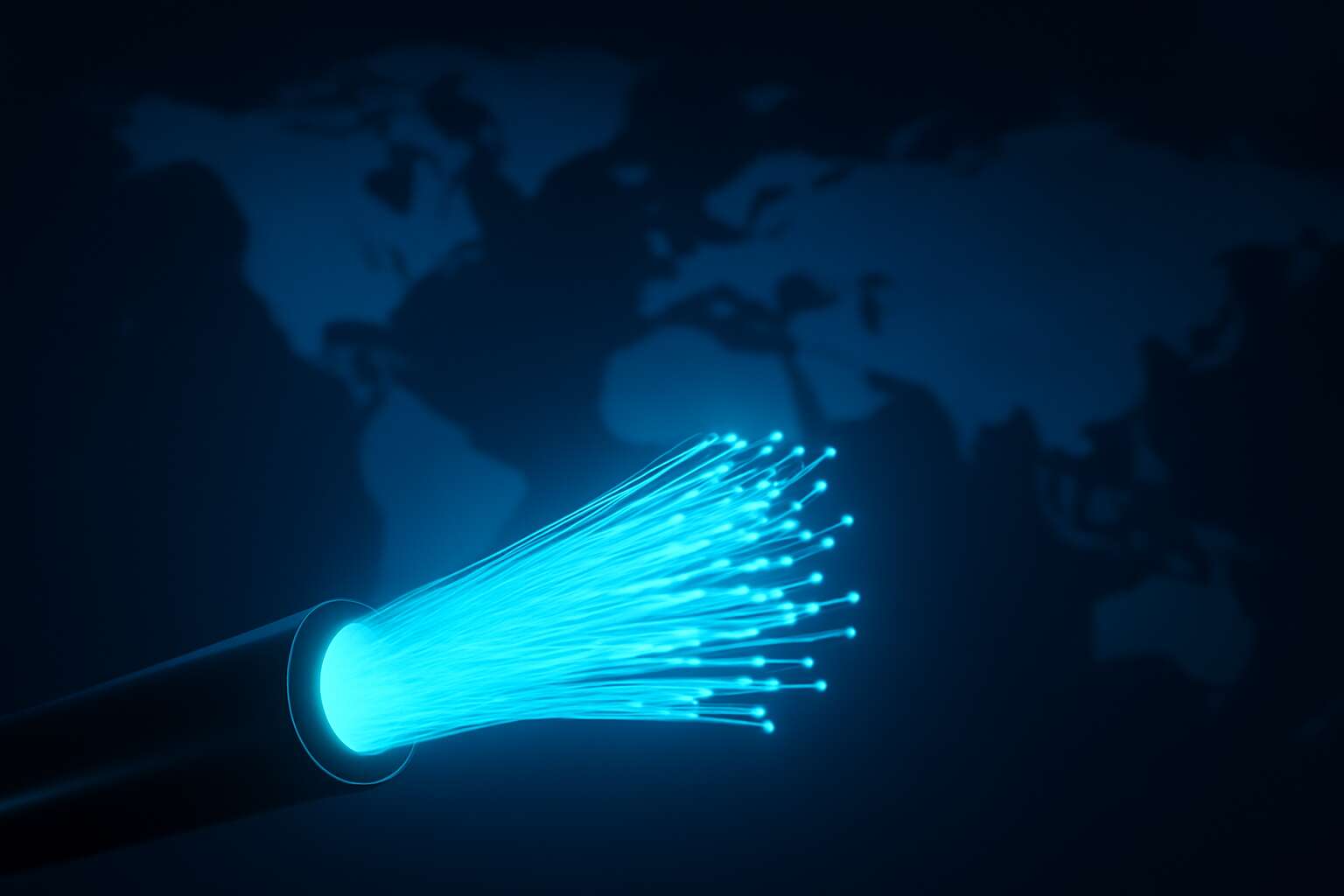
Historical milestones in fibre optic technology
Early experiments with light guiding
Today, more than 90% of the world’s long-distance data travels by fibre, a quiet miracle that draws Johannesburg and Cape Town closer. The question where was fibre optic cable invented threads through laboratories and dreamers who refined light into a living network for our era.
Early experiments with light guiding lit the way. In 1841, Colladon and Babinet demonstrated light guiding in a water-filled canal, hinting at a future where slender threads carry vast conversations! By the late 19th century, the dawn of total internal reflection became the quiet engine behind the fiber revolution.
From theory to tangible cables, milestones appear as gentle sparks:
- 1841: Colladon and Babinet demonstrate guided light in water
- 1966: Kao and Hockham propose high-purity silica fiber
- 1970: Corning develops a practical, low-loss optical fiber
Concept of total internal reflection
Across Africa, more than 99% of long-distance data travels by fibre, weaving Johannesburg and Cape Town into a single bright conversation. The question where was fibre optic cable invented persists, tracing a path from canal experiments to glass threads that carry voices and data across oceans. The journey hints at a future where tiny threads unite cities, industries, and families in a shared glow.
The quiet engine is total internal reflection, a hinge that keeps light trapped inside slender cores as it glides along long distances. From those early insights to practical, low-loss fibers, the craft of guiding light has grown into networks that power our modern world. In South Africa, this bright thread links universities, businesses, and communities with a shimmer that turns distance into connection.
First practical fibre optics proposals of the 1960s
In 1966, a whisper of future networks took shape: light could travel long distances through a hair-thin glass thread if losses dropped below about 20 dB per kilometer. This invites one to ask where was fibre optic cable invented, a tale beginning in theory and glass.
The first practical fibre optics proposals of the 1960s emerged from Kao and Hockham, who argued that purified silica could carry light with tolerable loss. Their paper in 1966 reframed glass from a curiosity into a substrate for networks.
- 1966 Kao and Hockham publish feasibility for purified silica fibers
- 1970 Corning demonstrates first practical low-loss fiber
These milestones stitched a path from canal experiments to global networks, and South Africa’s universities and telcos would soon embrace fiber to connect cities like Johannesburg and Cape Town.
Key dates: 1970s breakthroughs
By the mid-1970s, data could ride on a strand thinner than a human hair, and networks began crossing continents. This invites the question where was fibre optic cable invented—the answer is a shared arc from theory to glass, not a single lab achievement. The era bridged curiosity with manufacture, turning light into a rideable signal.
1970s breakthroughs brought practical, telecom-grade fibre closer to reality; Corning’s demonstrations cut losses enough to envision long-haul networks!
- 1970: Corning demonstrates the first practical low-loss silica fibre
- Mid-1970s: mass production techniques enable telecom-grade manufacture
- Late 1970s: single-mode fibres unlock longer distance links
South Africa’s universities and telcos soon embraced fibre, linking Johannesburg and Cape Town and shaping digital access in the region.
Influence of government and industry funding
A million light-borne packets cross the globe every second, yet the origin story isn’t a single lab; it’s a quiet collision of theory, glass, and policy. The thread runs through labs, ports, and policy, a mosaic of collaboration. The question where was fibre optic cable invented invites a shared arc—from curiosity to manufacture, from labs to rolling out networks. In the 1970s, breakthroughs and practical low-loss fibres pulled the future into view, and governments and industry funded the leap ahead. In South Africa, universities and telcos seized the moment, linking Johannesburg and Cape Town and shaping digital access for the region.
Historical milestones underpinned by funding include:
- Public investment in foundational optics research and early glassmaking
- Public-private partnerships that accelerated trials and scale
- Standards alignment and procurement incentives that kept rollout costs manageable
The story is a tapestry, a suspenseful ascent from theory to everyday connectivity.
Pioneers and key contributors to fibre optic invention
Foundational figures in optics research
Today, over 90% of global internet traffic rides the glow of fibre optics. The question of where was fibre optic cable invented unfurls like a lantern in a lab, where theory met glass and curiosity birthed a slender conduit of light!
Foundational figures in optics research shaped the path: Narinder Singh Kapany, Charles K. Kao, and George Hockham, whose names shimmer in the annals of light-guided cables.
- Narinder Singh Kapany
- Charles K. Kao
- George Hockham
In South Africa, these currents of discovery ripple through every campus and service provider, where bright fibres stitch towns to towns and ideas to markets. The lineage lives in the quiet precision of connectors, and in the bold question that keeps guiding design into the future.
Inventions by Narinder Singh Kapany and colleagues
In the glow of a lab, Narinder Singh Kapany and a band of curious alchemists stitched light into glass, earning him the nickname father of fiber optics. His early demonstrations turned loose a belief that slender fibers could carry images and signals far beyond lantern-grade clarity.
- Coined “fiber optics” and demonstrated light transmission through flexible fibers
- Laid groundwork for fiber bundles used in imaging and sensing
- Influenced later silica-core, cladding research with Kao and Hockham
The evergreen question—where was fibre optic cable invented—points toward a transatlantic lineage. In Britain, Kao and Hockham argued for high-purity silica and practical glass pipes; in the United States, Kapany’s teams pushed real-world fiber experiments. Today, South Africa’s campuses and service providers weave this legacy into urban networks.
Role of Corning Glass Works in fibre development
In the kiln-lit dawn of modern communications, Corning Glass Works sparked a turning point. In 1970, Maurer, Keck, and Schultz coaxed a practical, low-loss silica fiber from glass, turning a dream into a cable that could carry far more than light.
Corning’s craft built on decades of glass mastery, bridging theory and the cables that stitch continents.
- Pioneered ultra-pure silica production
- Developed the first practical low-loss fiber
- Scaled manufacturing for telecom networks
This invites the question where was fibre optic cable invented, a thread linking Britain’s theory to America’s hands, with Corning turning it into global infrastructure. For South Africa, the result is faster, more reliable links across cities.
Cross-disciplinary teams in physics and engineering
In the grand tapestry of modern communication, the journey of light is as much about people as equations. This is the kind of question where was fibre optic cable invented—Britain seeded the theory, America built the loom, and the rest of the world threaded in. Cross-disciplinary teams in physics and engineering stitched together mathematics with glassmaking, turning curiosity into capability.
From the UK, Charles Kao and George Hockham forged the early blueprint, their STL collaboration elevating ultra-pure silica from a bold idea to a solvable problem.
- Charles Kao — UK STL, theorist who identified ultra-pure silica as essential
- George Hockham — co-author, system-level thinker bridging physics and engineering
- Cross-disciplinary teams — physicists and engineers aligning labs with industry
Across the Atlantic, American labs transformed theory into practice, paving the way for networks that knit cities together. This cross-border collaboration underpins the SA telecom landscape today.
Academic institutions driving early innovation
As we ponder where was fibre optic cable invented, the answer unfolds from campus benches and lab benches alike. Across the globe, academic institutions became the quiet engines of innovation, uniting theoretical insight with hands-on glassmaking and meticulous testing. In Britain, leading universities fostered early exploration; in the United States, Stanford, MIT, and the University of Michigan translated ideas into working fibers that guided light more faithfully than ever before.
Notable centers of inquiry include:
- Imperial College London
- Stanford University and related laboratories
- University of Michigan
- Massachusetts Institute of Technology
From these scholarly roots, the global network matured, feeding modern South Africa’s telecom ambitions and reminding us that breakthroughs travel best on the backs of curious minds.
Technical breakthroughs enabling fibre optics
Understanding total internal reflection
The industry often asks where was fibre optic cable invented, and the answer lies in a lineage of patient glass work, clever refractive tricks, and stubborn experimentation. In the early 1970s, attenuation dropped dramatically—and light began moving farther with less loss. I’ve walked through labs where light is coaxed into a slender thread, and the room hums with possibility.
At the core is total internal reflection—light staying put in the glass as long as the core is more optically inviting than the cladding. Engineers adjusted purity, refractive indices, and microstructural consistency to turn a simple strand of glass into a reliable conduit for miles of signals across South Africa.
In this phase, breakthroughs mattered:
- Pure glass chemistry and controlled doping to reduce attenuation.
- Precision drawing and surface finishing to minimise scattering.
- Cost-effective manufacturing scales that brought long-haul fibre within reach.
These breakthroughs power South Africa’s fibre backbone, linking communities with speed and reliability.
Development of low-loss glass fibres
Attenuation dropped from the era’s rough 100 dB/km range to single digits by 1970—a revolution that turned light into a city-size courier. That momentum transformed fiber optics from a laboratory curiosity into a global backbone, quietly rewriting how information travels.
Technical breakthroughs followed: new chemistry of glass and controlled impurity suppression, smarter preform techniques, and improved drawing processes that reduce micro-scatter. Engineers experimented with compositions and stresses until fibers behaved like quiet threads, guiding signals mile after mile with far less loss.
Consider these pivotal advances:
- Highly uniform preforms with improved index control
- Durable, protective coatings to shield the fiber core
- Scalable drawing and annealing processes that maintain consistency
The question where was fibre optic cable invented has a winding history that includes South Africa’s pioneering labs, where engineers translate global breakthroughs into local networks that hum with speed.
Advances in optical fibre fabrication methods
Across farms, towns, and quiet laboratories, the push to lighter, tougher glass changed everything. The question of where was fibre optic cable invented is not a single-room tale—it’s a corridor of labs and trials across continents, including small yet determined South African workshops where patience meets precision.
From cleaner chemistry to steadier draws, a few breakthroughs stand out:
- Uniform preforms with precise refractive index tuning
- Robust protective coatings guarding the core
- Scaled drawing with controlled annealing for consistency
In South Africa, engineers translate global breakthroughs into local networks that hum with speed. Rural towns glow a little brighter as clinics, schools, and shops gain dependable connections!
Efficient light sources and detectors
Light travels farther, faster, and with more certainty than ever before. The networks that power clinics and classrooms now whisper at the speed of thought, yet the origin story remains a corridor of pivotal moments.
Efficient light sources, from compact laser diodes to infrared LEDs, paired with sensitive detectors, flipped fibre optics from experiment to everyday backbone. The question where was fibre optic cable invented travels across continents, including South Africa, where labs turn breakthroughs into usable networks.
Across universities and industry workshops, a quiet momentum builds. Extraordinary patience meets precision as glass—and the photons it carries—find new routes into schools and clinics, stitching communities with dependable speed.
Photon by photon, the world hums a little brighter.
Coatings, cladding, and protective fibres
In a world where a single strand can carry terabits per second, fibre optics feels almost inevitable. The question—where was fibre optic cable invented—echoes through labs, from origin stories to today’s rugged networks.
Breakthroughs in coatings, cladding, and protective jackets are the quiet engines. A smooth glass core, armored by precise coatings, keeps light from leaking; cladding with a lower index preserves the guided path across long journeys.
- Moisture- and UV-resistant polymer coatings
- Low-refractive-index claddings for tight light trapping
- Protective jackets against abrasion and moisture ingress
- Aramid-strength layers to resist tension
In South Africa, innovators adapt these layers for schools, clinics, and rugged terrain. The quest for discovery—the phrase where was fibre optic cable invented—still informs local collaborations with universities and industry.
Impact and applications across industries
Telecommunications backbone and long-haul networks
Across the global quest to connect more people, the fibre optic backbone moves information at light speed. The question where was fibre optic cable invented has long since become less important than where it is powering Africa’s digital economy. The telecom backbone and long-haul networks rely on ultra-pure glass and precise fabrication to keep data flowing across continents.
In practice, fibre underpins core networks with resilience and capacity.
- Backbone redundancy and traffic management
- Undersea cables linking continents and oceans
- Rural connectivity to bridge the digital divide
- Data centers, cloud services, and enterprise networks
That practical reach touches grids, hospitals, schools, and enterprise networks across South Africa.
For South Africa’s expanding digital economy, such backbones are more than tech; they shape public life and everyday business, quietly driving policy choices and investment in long-haul routes.
Undersea fibre optic cables
Undersea fibre optic cables don’t just ferry emails; they anchor economies. The question “where was fibre optic cable invented” is eclipsed by the reality that a single subsea link can unlock new markets for South Africa. These cables stitch continents, enabling banks to settle trades in milliseconds, researchers to collaborate across time zones, and hospitals to share patient data securely.
Impact spans industries pulled together by the quiet hum of glass threads beneath the sea. Consider these applications:
- Finance and fintech with ultra-low latency
- Healthcare data exchange and telemedicine
- Education, research networks, and government services
Where these cables land, resilience follows: diverse routes, maintenance regimes, and investment in long-haul routes shape South Africa’s digital infrastructure and its role in a connected Africa.
Fiber in data centers and cloud networks
From Cape Town’s coast to Johannesburg’s tech hubs, the question of where was fibre optic cable invented often reads like a passport stamp rather than a single invention. More than 99% of international data travels via fibre optic cables, revealing a global chorus—bright minds collaborating across labs, industries, and oceans to coax light into long-haul corridors.
Impact spans industries pulled together by the quiet hum of glass threads beneath the sea. Consider these applications:
- Finance and fintech with ultra-low latency
- Healthcare data exchange and telemedicine
- Education, research networks, and government services
Inside data centers and cloud networks, fibre optics power fast, reliable connections that scale with demand. Landings in Southern Africa strengthen resilience through diverse routes and proactive maintenance, turning a global backbone into a local advantage for businesses, researchers, and public services.
Medical and sensing applications
Across industries, fibre optics carry quiet revolutions—light guiding medicine, memory, and momentum through networks. The enduring question of where was fibre optic cable invented still echoes in labs and hospitals alike, because a single glass thread can sharpen diagnoses and widen access to care. In South Africa’s healthcare corridors and remote clinics, these strands stitch together data, images, and insight with astonishing speed!
In medicine and sensing, the impact is tangible:
- Non-invasive imaging and diagnostics
- Real-time tissue monitoring during procedures
- Biosensors for continuous patient data
- Environmental and industrial sensing in laboratories
These applications extend beyond hospitals into research and rural logistics, turning light into a trusted ally for outcomes that matter.
Emerging uses in smart infrastructure
Across industries, fibre optics are lighting pathways from mines to cities. In South Africa, smart infrastructure hinges on photons streaming through glass, powering sensors that map traffic, energy use, and weather patterns, with pilots reporting up to 30% faster data flow. The enduring question where was fibre optic cable invented still echoes in labs and planning rooms, nudging researchers toward the next leap in reliability and speed.
Emerging uses in smart infrastructure include:
- Urban fibre networks powering adaptive traffic systems and public safety sensors
- Real-time environmental and resource monitoring for ports, mines, and farms
- Backbone support for data centers and cloud-connected services
Across manufacturing, logistics, and healthcare-adjacent research, light-guided sensing is turning data into safer, faster decisions—tightening the loop between intention and outcome.
0 Comments