
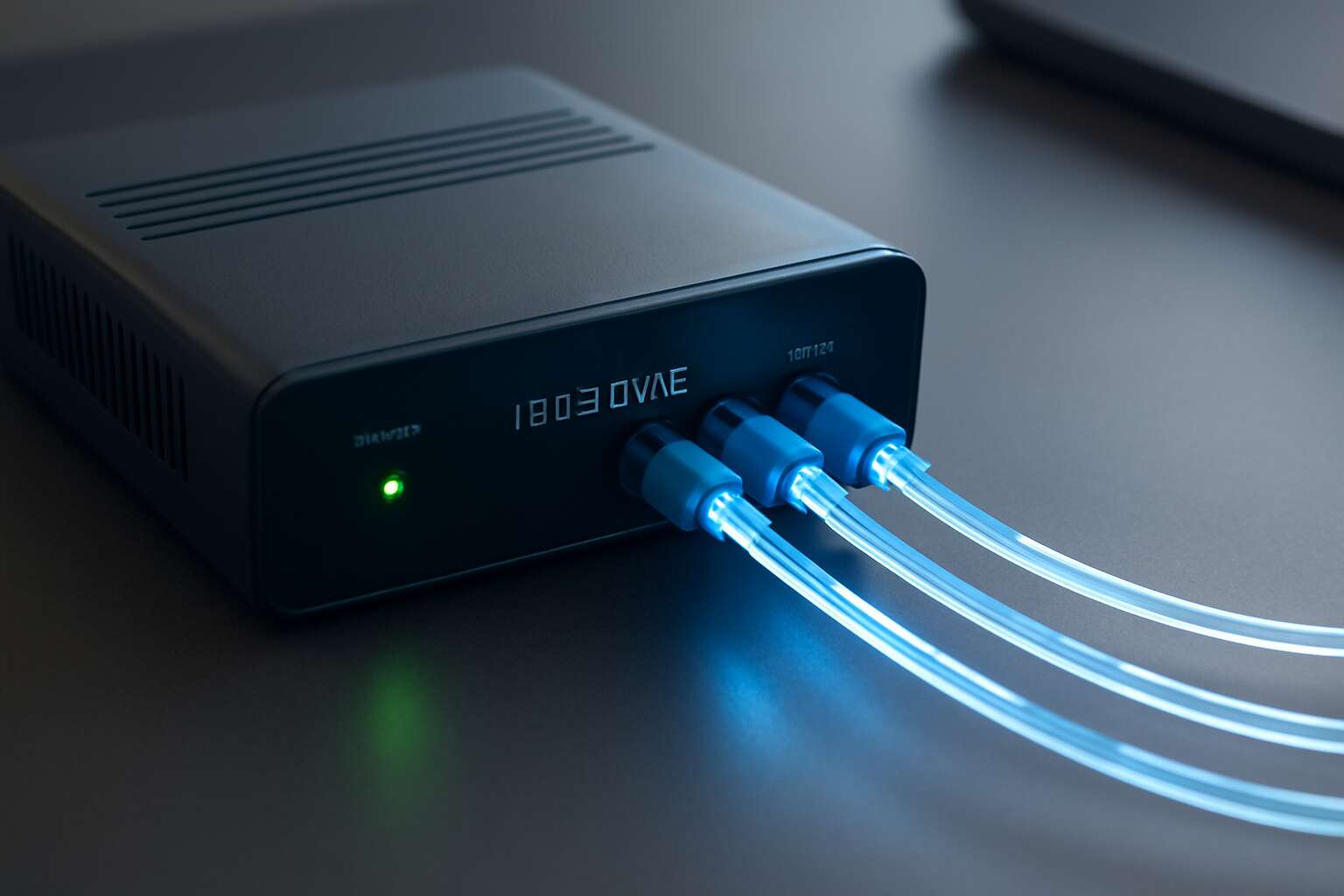
Understanding fibre optic extenders
Overview of what it is
Connections remember distance—and in South Africa’s buzzing business landscape, a fibre optic extender acts as a quiet sentinel, reviving a fading signal and pushing it farther without laying new cable.
Think of it as a smart relay placed along a fibre link: it regenerates the optical signal, compensating for loss and preserving speed over longer runs. This resilience makes it ideal for campuses, remote offices, or CCTV networks where reliability matters most. See it at work in these scenarios:
- connecting distant office buildings
- expanding CCTV networks across campuses
- linking data centres and research facilities
How it works
In SA’s buzzing business landscape, signal loss over distance is the quiet killer; a fibre optic extender is the hero that keeps the data flowing.
Placed mid-link, it detects the pulse, regenerates the optical signal, and compensates for attenuation so speed stays blistering over longer runs. A fibre optic extender does this by refreshing the light as it travels, preserving integrity without pulling in new cable.
- Regenerates the optical signal to restore strength
- Compensates for attenuation and dispersion
- Extends reach without laying new fibre
That means reliable campus links, extended CCTV networks, and data-centre interconnects across South Africa’s tech hubs.
Common use cases
Distance gnaws at performance, especially in South Africa’s sprawling campuses and industrial parks. A fibre optic extender acts as the steady hand in the relay race, catching the light and restoring strength where the link would otherwise fray. It refreshes the signal mid-run, delivering clarity across longer distances without inviting new cable. In practical terms, it means fewer interruptions and more consistent throughput.
Understanding where these devices shine helps map smarter networks across the country.
- Extending CCTV backbones on campuses, industrial sites, and townships.
- Connecting buildings on large university and corporate campuses.
- Providing rural or edge backhaul between remote facilities.
- Strengthening data-centre interconnects and core IT links.
These configurations endure the SA landscape, keeping critical services—schools, clinics, and businesses—connected when distance seems to stretch the line.
Types and configurations for fibre optic extenders
Single-mode vs multimode considerations
In South Africa’s bustling network spaces, uptime isn’t negotiable—99.9% is the benchmark many enterprises chase. A fibre optic extender can stretch high-speed signals across rooms and campuses without sacrificing performance.
For many deployments, the choice between single-mode and multimode isn’t just technical—it shapes cost, distance, and reliability.
- Single-mode offers exceptional reach, using a narrow core (about 9 μm) and laser transmission for long-distance links.
- Multimode keeps costs lower for shorter runs, using a larger core (50/62.5 μm) and LED sources that suit inside buildings.
Ultimately, the right configuration hinges on distance, connector types, and traffic patterns; in South Africa’s evolving networks, the system you choose can be the difference between bottlenecks and reliable throughput.
Extender vs repeater distinctions
Types and configurations for fibre optic extenders aren’t about gadgets; they’re about architecture. A fibre optic extender can be deployed as a lean point-to-point link or as part of a modular distribution scheme, carving new corridors for data. Extenders and their cousins, repeaters, share a mission: refresh the signal so distance doesn’t erode throughput. In compact campuses, the choice hinges on footprint, power, and how traffic flows between rooms.
- Point-to-point extenders that regenerate signals for longer runs beyond the reach of a single cable
- Modular extenders that slot into racks for scalable, multi-room distribution
- Bi-directional or multi-point options designed to support simultaneous uplinks without bottlenecks
In South Africa’s evolving networks, alignment with physical layouts and demand is essential—the fibre optic extender you select becomes the quiet engine behind reliable throughput.
Plug-and-play vs managed options
In South Africa, even a minute of downtime can cost a campus thousands in lost productivity—an unseen price tag that tightens the spine of a network. A fibre optic extender isn’t a gadget; it’s architecture, a keystone that redraws data corridors with precision. When the plan calls for lean runs or sprawling floors, it becomes the quiet engine behind reliable throughput.
Plug-and-play extenders offer instant relief for simple, point-to-point runs. They regenerate signals automatically, with zero configuration required, so rooms connect in minutes rather than hours. For larger campuses, managed options step in—providing visibility, control, and resilience as traffic flows through racks and across floors.
- Plug-and-play: quick deployment, minimal IT touch, ideal for straightforward links.
- Managed options: dashboards, QoS, VLAN tagging, remote monitoring.
- Flexible topology: supports multi-room distribution without re-wiring.
In SA’s evolving network landscape, matching the extender’s configuration to the physical layout matters. Whether you lean into lean point-to-point or a modular, multi-room scheme, the choice influences latency, power footprint, and future scale.
Power and optical budget considerations
In South Africa’s bustling campuses, every minute of downtime costs more than a coffee break—it’s lost productivity and a stubborn bottleneck. A fibre optic extender isn’t a gadget; it’s architecture, a keystone that redraws data corridors for lean runs or sprawling floors. It’s the quiet engine behind reliable throughput. I’ve watched teams cut downtime by choosing the right topology.
Types and configurations come down to topology and modularity. The device can be a compact, stand-alone unit for point-to-point links or a modular chassis that scales across rooms. Think plug-in optics, hot-swappable modules, and smart management features that match your campus’s rhythm.
- Point-to-point rigs for straightforward, fast wins
- Multi-room distributions with cascaded extenders
- Rack-to-rack deployments in data corridors
Power and optical budget considerations are not optional extras. Active extenders demand sensible power planning, and the optical budget—sum of transmitter power, fibre losses, and receiver sensitivity—will determine whether throughput stays crisp or negotiates a late-night nap with network gremlins.
Wavelength compatibility and accessories
Across South Africa’s bustling campuses, downtime costs more than a pricey coffee—it’s lost lectures, stalled labs, and delayed research. A fibre optic extender isn’t a gadget; it’s architecture, a keystone that redraws data corridors toward lean, reliable throughput.
Types and configurations come down to topology and modularity. The device can be a compact stand-alone unit for point-to-point links or a modular chassis that scales across rooms. Think plug-in optics, hot-swappable modules, and smart management features that match your campus’s rhythm.
- Point-to-point rigs for straightforward, fast wins
- Multi-room distributions with cascaded extenders
- Rack-to-rack deployments in data corridors
Wavelength compatibility and accessories keep the system practical. Common wavelengths include 1310 nm and 1550 nm for longer runs, with multimode options for shorter hops. Accessories like transceivers, jumpers, dust caps, and mounting hardware are the quiet workhorses behind a neat, dependable install.
Scalability and futureproofing
Across South Africa’s campuses, topology becomes the quiet architect of speed. A fibre optic extender isn’t a gadget—it’s a pathway—carefully threaded corridors of data that scale as labs grow and lectures stack. Modular, future-ready, it invites lean throughput without surrendering reliability!
Types and configurations hinge on topology and modularity—compact stand-alone units for point-to-point links, or modular chassis that grow with your campus. Think plug-in optics, hot-swappable modules, and smart management that match the rhythm of a busy lab and lecture hall.
- Point-to-point rigs for straightforward, fast wins
- Multi-room cascades across corridors
- Rack-to-rack deployments in data corridors
Scalability is a living plan, a fabric that breathes with demand. With hot-swappable modules and evolving optics, a well-chosen extender can carry a campus from lecture capture to real-time simulations without a rewire. It’s futureproofing that stays nimble as bandwidth expectations rise and research workflows shift!
Installation and deployment strategies
Site survey and planning
Deploying a fibre optic extender in South Africa’s busy offices demands more than a box of cables and a confident shrug. Installation and deployment strategies hinge on thoughtful site survey and planning, where the lay of the land—the floors, the ceilings, the IT closet—tells the true story. The aim is to map fibre routes, anticipate interference from HVAC corridors, and accommodate power quirks common to local sites without breaking the mood or the budget. A graceful rollout respects the space, the schedule, and the people who depend on steady connectivity each workday.
Key site survey elements to consider include:
- Current fibre routes and space constraints
- Power reliability and environmental conditions
- Access permissions and safety compliance
With these considerations in place, the deployment language remains fluent, and the network hums with quiet confidence.
Physical installation steps
Across South Africa’s bustling offices, 87% of network faults trace back to shoddy installation, a statistic that haunts the fibre optic extender with quiet inevitability. The art of installation and deployment strategies rests on a careful choreography—walls, ceilings, IT closets, and cabling trays whispering their demands. The aim is to weave a reliable thread through the building without disruption, balancing performance with the human tempo of the workday!
In practice, the approach honours safety, local compliance, and power discipline; guidelines from manufacturers guide the hand, while the environment becomes a collaborator rather than an obstacle. Enclosures, routed pathways, and restraint-free mounting are chosen to endure, so the network hums with restrained power and a patient glow of stability.
Testing and validation
87% of network faults trace back to shoddy installation, and the clock is ticking when a live link stutters. For a fibre optic extender, testing and validation is the final act of faith, turning potential into performance. We validate not just reach, but reliability, ensuring the human tempo of the workspace keeps humming.
Begin with bench-style checks that mirror field realities: clean and inspect connectors, confirm power budget margins, and verify wavelength compatibility. Then move to live tests that stress the link across its expected span: throughput, jitter, and BER under typical business loads. The aim is a stable glow, not a momentary sparkle.
- Pre-activation power and budget verification
- Link integrity and latency measurements
- Environmental and vibration tolerance observation
Document results, create a baseline, and plan for periodic revalidation as the network grows.
Performance, reliability, and maintenance
Throughput and latency expectations
Performance with a fibre optic extender is about consistency as much as speed. As one IT director quips, “Speed is vanity; latency is reality.” In South Africa’s varied networks, you want a link that holds throughput steady and keeps latency tight, regardless of distance or EMI. When the optical budget is set with care, you get reliable performance that feels almost magical—without the smoke and mirrors!
Reliability hinges on clean connections, proper enclosure, and regular monitoring. Throughput and latency expectations depend on heat, fiber quality, and firmware health; maintain a healthy budget and redundant paths to dodge downtime.
Maintenance is practical, not mystical:
- Connector integrity and maintenance visibility
- Firmware health and monitoring systems
- Power redundancy and environmental resilience
The result: lower MTTR, fewer surprises, and a network that behaves like a well-trained relay team.
Signal integrity and error handling
Latency is reality—speed is vanity. In South Africa’s varied networks, a fibre optic extender must deliver more than speed; it must hold throughput steady and keep latency tight, no matter distance or EMI. When the optical budget is tuned with care, performance feels almost magical—reliable, predictable, and reassuring!
Reliability rests on clean connections, proper enclosure, and steady monitoring. In such a link, throughput and latency hinge on heat, fiber quality, and firmware health; maintain a healthy budget and redundant paths to dodge downtime. Quiet, consistent operation is the quiet victory of a well-tuned system.
Maintenance and signal integrity go hand in hand. Discipline matters more than mystique in maintenance. Look for regular checks of error rates, drift monitoring, and built-in redundancy to keep downtime minimal!
- Regular checks of error rates to catch drift early
- Temperature and EMI drift monitoring
- Redundant paths with fast fault isolation
Routine maintenance and firmware updates
Performance in South Africa’s network tapestry demands more than sheer speed. A fibre optic extender must hold throughput steady and keep latency tight across long spans, shrugging off EMI and heat like a veteran matador. When optical budget, fiber quality, and firmware health align, the result feels almost magical—reliable, predictable, and reassuring!
Reliability rests on clean connections and sturdy enclosures, but routine maintenance and firmware updates are the quiet backbone. Here are the essentials:
- Regular checks of error rates to catch drift early
- Temperature and EMI drift monitoring
- Redundant paths with fast fault isolation
Keep it in balanced humour: maintenance discipline beats mystique every time. A well-tuned system avoids downtime through steady monitoring and predictable operation—less drama, more bandwidth sanity for the fibre optic extender.
Troubleshooting common issues
Across South Africa’s enterprise network tapestry, uptime isn’t optional—it’s a contract with users. A fibre optic extender must keep throughput steady and latency tight across long spans, shrugging off heat and EMI like a seasoned matador.
Reliability rests on robust enclosures and clean optical paths. When alignment, shielding, and environmental control align, performance feels almost magical—predictable, scalable, and reassuring. A well-tuned fibre optic extender keeps dialogue between devices crisp and constant.
- Drift and error-rate trends that warn before trouble
- Ambient temperature and EMI fluctuations that ripple timing
- Redundant paths and fast fault isolation to preserve service
Trust comes from watching the quiet signs—the numbers, the heat, the hum—and knowing a system that listens stays alive longer than any drama.
Redundancy and failover options
In South Africa’s bustling enterprise lanes, uptime isn’t a goal—it’s a covenant. A fibre optic extender acts as the quiet pulse of a network, delivering steady throughput and tight latency even as heat climbs and EMI whispers through the cables.
Reliability rests on robust enclosures, clean optical paths, and disciplined environmental control. When alignment holds, shielding is steadfast, and maintenance is routine, performance stays predictable, scalable, and calm—like a well-tuned instrument under a bright, attentive conductor.
Redundancy and failover options ensure service even when a link blinks.
- Dual fibre paths with automatic switchover
- Ring or mesh topology for path diversity
- Hot-swappable transceivers and power supply redundancy
- Remote health monitoring and alerting



0 Comments